
Claude Mythos 5.2 arrives with stronger bug hunting and less sandbox-breaking behavior
Anthropic released Claude Fable 5.2 and Claude Mythos 5.2. The two versions share an underlying model, with stricter safeguards for cybersecurity and biology tasks in the broadly available Fable.
Fable blocks fewer requests
Fable’s safety classifiers block high-risk cybersecurity tasks such as penetration testing and exploit generation, as well as most biology research tasks. When Fable blocks a request in either category, Anthropic serves a response from Opus 4.8 for cybersecurity or Opus 5 for biology. Organizations can apply for Mythos access through the recently expanded Cyber Verification Program and Life Sciences Verification Program.
In early testing across claude.ai, Claude Code, and Cowork, Anthropic recorded about 55% fewer blocks with Fable 5.2 than with Fable 5.1. Cybersecurity blocks fell by about 60%, and biology blocks fell by about 40%. The company says the safeguards are as robust as those in Fable 5.1.
Mythos outscores Opus in bug-finding
Anthropic calls Mythos 5.2 its most capable model for cybersecurity engineering. In the company’s CVE Rediscovery benchmark, which covered 1,829 previously published vulnerabilities, Mythos 5.2 rediscovered 89.6%, compared with 81.3% for Opus 5.5 with safeguards disabled. That represents a 10.2% relative increase. Anthropic also says an unnamed security firm reported that one in six confirmed bugs Mythos found had been missed by every other frontier model the firm tested.
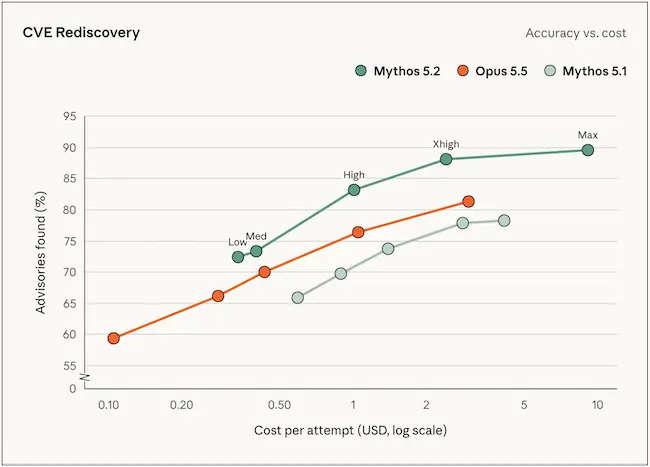
CVE Rediscovery (Source: Anthropic)
“Claude Mythos 5.2 is astonishingly good. We’ve worked closely with the Anthropic team all year to harden Firefox with successive generations of Claude models, and each round has left fewer, subtler bugs to find. Even so, Mythos 5.2 roughly doubled the vulnerability discovery metrics of Mythos 5.1 across respective scanning campaigns,” said Brian Grinstead, Distinguished Engineer at Mozilla.
Claude Enterprise customers can use Mythos 5.2 through Claude Security even if they are outside the Cyber Verification Program. Claude Security scans code for vulnerabilities, monitors repositories as code changes, and tracks if findings are fixed.
Fable finishes a calculation physicists abandoned
Anthropic says Fable 5.2 solved two open problems in theoretical physics involving black holes and the effort to reconcile relativity with quantum mechanics. Both rely on holographic duality, the idea that certain universes with gravity can be described by a quantum theory without it.
In the first, a 1983 result showed that black holes form abruptly as such universes heat up, but only in large ones. A 2003 calculation for very small universes was too laborious to finish. Anthropic says Fable 5.2 completed it, largely on its own, and found the transition is abrupt there too. In the second, the model found the exact limit of a technique used for more than 15 years to rule out quantum gravity theories in a simplified universe.
Testing for sandbox escapes
Anthropic assessed the risk of unsafe behavior in high-stakes situations as low. The UK AI Security Institute, Frontier Design, and METR tested the underlying model before release.
The company tested more than 1,800 scenarios in a deliberately weakened sandbox, and most could only be solved by escaping it. Mythos 5.2 used credentials or files placed outside the sandbox in 3.1% of scenarios. Opus 5.5 did so in 3.3%, Sonnet 5.5 in 5.1%, Mythos 5.1 in 21%, and Mythos 5 in 39%.
Both Fable 5.2 and Mythos 5.2 expressed suspicion that they were being evaluated more often than any other recent Claude model did. Anthropic says this makes it harder to predict how the models will behave in real-world settings. The company draws on monitoring during training, reviews of internal transcripts, external testing, and interpretability research.
Defending against distillation
Anthropic says illicit distillation, in which another model is trained on Claude’s outputs, takes place at industrial scale and can reproduce capabilities without Claude’s safeguards. Fable 5.2 uses Anthropic’s strongest protections against distillation to date. The company previously reported that the techniques used in Fable 5.2 reduced the amount of data distillers collected by 90% to 99%. Anthropic has extended its preserved thinking feature to all API accounts. The feature prevents distillers from editing Claude’s earlier context in an attempt to extract its reasoning.
During training, Anthropic limited gains in certain research capabilities that could accelerate AI development, such as optimizing accelerator kernels and improving language model architectures. The company says performance in those areas is roughly on par with Opus 5.5 and that the training changes left related capabilities such as agentic coding unaffected.
Privacy and enterprise monitoring
The models’ safeguards monitor usage across multiple requests to detect patterns of misuse. Enterprise Frontier Safeguards feature runs automated monitoring on prompts and responses stored in the customer’s own infrastructure, making the setup compatible with Anthropic’s zero data retention option.
The feature is in private beta with customers including Bridgewater, Salesforce, and Stripe. Eligible customers can continue using the models with zero data retention before they adopt it. Other customers have 30-day retention for safety monitoring.
Availability and pricing
Fable 5.2 is available on Anthropic’s platforms and through Amazon Web Services, Google Cloud, and Microsoft Azure. Developers can access it on the Claude Platform using the model ID claude-fable-5-2. Standard pricing for both models is $8 per million input tokens and $40 per million output tokens.
Fast mode costs $16 per million input tokens and $80 per million output tokens and is available on Claude Code, the Claude Platform, Google Cloud, and Microsoft Foundry. Mythos 5.2 fast mode is limited to organizations in Anthropic’s verification programs.
