More than 4,400 malicious domains are waiting for holiday shoppers
Cybercriminals are positioned to exploit the holiday shopping season through fraudulent storefronts, retailer impersonation, payment fraud and account takeover attacks, according to FortiGuard Labs’ Holiday Season Cyber Threats Report 2026.
Researchers identified more than 24,000 newly registered domains containing keywords associated with seasonal shopping over a 90-day period, including more than 4,400 classified as malicious. Underground marketplaces are facilitating the trade in stolen customer information, access to e-commerce infrastructure and services that support financial fraud.
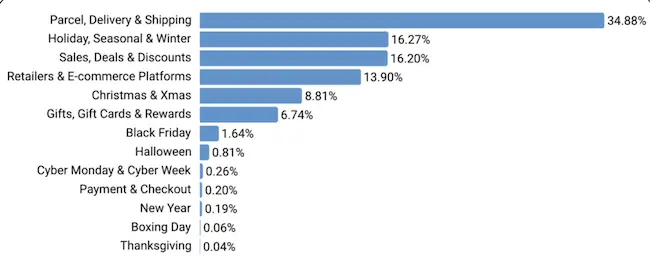
Distribution of holiday-related themes across the newly-registered domain dataset (Source: FortiGuard Labs)
Delivery scams and retailer impersonation
Parcel, delivery and shipping terminology accounted for 34.88% of newly registered holiday-related domains, making it the most prevalent theme in the dataset. Other registrations incorporated references to discounts, rewards, gift cards and retail brands.
Attackers can use imitation delivery websites to request payment information under the pretext of missed deliveries, customs fees or delivery rescheduling. Domains referencing DHL, UPS, FedEx and USPS were identified during the investigation.
Researchers identified a fraudulent website impersonating Walmart and advertising Black Friday deals. The storefront reproduced the retailer’s branding, color scheme and product listings to create the appearance of a legitimate shopping destination.
Consumers directed to such websites through advertisements, search results or promotional emails could be tricked into disclosing login credentials, submitting payment information or purchasing products that never arrive.
Fraudulent storefronts do not always rely on impersonating retailers in domain names. Separate research from Doppel found that Black Friday scams began appearing earlier this year, with most confirmed fake pages using web addresses that do not resemble those of the impersonated brands. Approximately one in four lookalike pages were hosted on legitimate platforms such as Google Sites, Blogger and GitHub Pages.
More than 1.7 million retail-related infostealer logs circulate underground
Between August and October 2026, researchers collected approximately 1.72 million infostealer log entries associated with seven major e-commerce platforms from a Russian marketplace. Amazon accounted for approximately 1.49 million entries, followed by eBay with 82,900 and AliExpress with 66,410.
Infostealer malware extracts browser-stored credentials, session cookies, autofill data and other sensitive information from infected devices. Criminals categorize these records by domain, geography and account type, allowing buyers to locate information associated with specific retailers.
“Stolen session cookies may potentially be reused to hijack authenticated sessions, depending on their validity and the security controls implemented by the affected platforms,” the researchers explained.
Stolen credentials and session data could enable unauthorized account access, fraudulent purchases and misuse of stored payment information.
Cybercrime services facilitate retail fraud
Underground forums contain advertisements for subscription-based phishing services, automated payment card validation tools and phishing kits advertised as capable of bypassing MFA.
Criminals are advertising banking credentials, compromised gift card information and access to merchant systems. Fraudulently obtained gift cards can be resold or converted into cash or cryptocurrency.
Researchers also identified an advertised refund-as-a-service operation targeting retailers, food delivery companies, electronics vendors and travel platforms. The operator claims to secure refunds on purchases in exchange for a commission. Such services could exploit return policies and customer support processes.
Communications infrastructure is another component of the underground economy. Listings advertise caller ID spoofing, SMS delivery and bulk email distribution services that could support impersonation campaigns.
Sellers also advertise ready-made social media accounts, advertising campaign management and artificial engagement services. Purchased followers, comments and views could make fraudulent social media profiles and deceptive product advertisements appear more credible.
E-commerce vulnerabilities put retailers at risk
Cybercrime forums contain advertisements for alleged zero-day vulnerabilities, exploit chains and unauthorized access to e-commerce platforms such as Magento, PrestaShop, WordPress and OpenCart.
Access to compromised retail infrastructure could allow attackers to modify checkout pages, deploy payment-skimming scripts, redirect shoppers to fraudulent payment pages and extract customer databases.
Documented exploitation of vulnerabilities affecting Adobe Commerce (Magento) and other web application environments adds to the risks facing online businesses. Security flaws involving remote code execution, unrestricted file uploads and authorization bypass can leave merchant systems vulnerable to compromise.
AI tools enter the holiday fraud ecosystem
Cybercriminals are exploring the use of AI to automate parts of their operations, develop malicious software and produce social engineering content tailored to specific audiences.
One forum user sought an unrestricted LLM capable of generating Romanian-language communications that reflect local financial practices. Such capabilities could make fraudulent messages more convincing to recipients.
Another user described developing an orchestration framework that reportedly coordinates multiple AI agents. The developer claims the framework can circumvent model safety restrictions. Such systems could reduce the manual effort involved in reconnaissance and attack development.
AI-generated videos present another potential avenue for deception. Commercial media generation platforms could be misused to produce fabricated customer testimonials, misleading product demonstrations and advertisements impersonating established brands.