Security+ builds the foundation. SSCP proves you can execute
Cybersecurity knowledge and operational readiness: why both matter
Consider this threat scenario: Systems go down, alerts escalate, response windows shrink. In today’s high-stakes world, cybersecurity professionals need more than theoretical knowledge — they need operational readiness.
For many practitioners, the journey begins with building a solid conceptual foundation, but the true test of a professional lies in their ability to maintain a “ready state,” evolving from a student of the craft to a mission-ready practitioner always operationally ready to defend critical infrastructure.
This evolution is best represented by two complementary certifications: CompTIA Security+ and ISC2 Systems Security Certified Practitioner (SSCP). Security+ builds the essential foundation, and SSCP proves you can execute the mission.
Why foundational knowledge matters
Many successful practitioners begin with an introduction to the core principles of their field. In cybersecurity, foundational training establishes the language and concepts required to contribute meaningfully. This is where Security+ plays a vital role. It serves as a broad entry point that introduces the “how and what” of the industry.
Foundational knowledge enables a practitioner to:
- Establish a common language: It ensures every team member understands the same terminology, from the CIA (Confidentiality, Integrity and Availability) triad to the nuances of different threat actors.
- Enter the career field: For those starting out or transitioning from IT roles, foundational training is the primary gatekeeper for entry-level positions.
Without a base of knowledge, individuals lack the framework to understand why certain protocols exist. They’re unable to secure a network if they fail to understand the fundamental protocols that govern it, and they cannot manage risk if they’re unable to identify vulnerabilities.
Security+ verifies the institutional knowledge that serves as an essential baseline for cybersecurity professionals. It provides a broad survey of critical domains, ensuring you understand:
- Threats and vulnerabilities: Recognizing attack vectors and the threat actors behind them
- Access control: The fundamental principles of who gets in and what they can do
- Risk management: Applying core concepts like the CIA triad, least privilege and separation of duties
- Incident response fundamentals: Understanding the theoretical life cycle of a breach, from preparation to recovery
- Network security basics: The foundational protocols of data in motion
Why operational readiness matters
While foundational knowledge allows you to explain a concept, operational readiness demonstrates you’re ready to execute it under real-world constraints.
Operational readiness is about execution under pressure. It is the transition from learning concepts to applying them in real time. Employers value practitioners who don’t just know security but can monitor, implement, respond and adapt in environments where there is no room to second-guess.
Consider these three real-world scenarios:
1. The skeleton crew (Friday, 4:47 p.m.): Monitoring alerts show unusual data exfiltration. Your manager is gone, and the rest of the leadership team is unreachable. Do you have the operational judgment to move without hesitation, or do you freeze because the scenario wasn’t in the textbook?
2. The zero-day (Monday, 9:15 a.m.): A critical vulnerability is on the news. Your CIO demands to know if the organization is exposed and what your plan is. You have 60 seconds to provide an answer that dictates the organization’s next 48 hours.
3. The acquisition (Tuesday, 11:20 a.m.): Your company has just acquired a new firm. You have 48 hours to assess its security posture using only a messy network diagram and administrative credentials. Where do you start?
Where SSCP fits in: The operational standard
While foundational certifications provide the “basic training,” SSCP serves as the “operational qualification.” SSCP is specifically designed for professionals responsible for the hands-on implementation and administration of IT infrastructure.
Building upon foundational certifications that validate knowledge, SSCP validates operational capability. Certification requires one year of cumulative, hands-on operational experience. If you haven’t acquired the experience yet, you can pass the SSCP exam first and become an Associate of ISC2, then earn the required experience within two years.
SSCP focuses on seven critical domains of operational security:
1. Security concepts and practices: Implementing technical and administrative controls
2. Access controls: Managing identity life cycles and authentication methods like multifactor authentication (MFA) and single sign-on (SSO)
3. Risk identification, monitoring and analysis: Turning thousands of daily SIEM events into actionable intelligence
4. Incident response and recovery: Executing containment and coordinating recovery while the business is offline
5. Cryptography: Implementing encryption and managing PKI without breaking production functionality
6. Network and communications security: Segmenting networks and configuring firewalls while maintaining performance
7. Systems and application security: Securing cloud migrations and endpoint protection across diverse devices
The evolution from learning to readiness
Security+ helps professionals learn the “how and what” — the frameworks and procedures required of the industry. SSCP then validates the “why and when” — the operational judgment developed through proven experience. Together, they create the complete operational professional. As Adam Gorecki, SSCP, Information Systems Security Analyst, explains, “SSCP deepened my knowledge of information security and has given me new opportunities to further my career.”
For those in the military or DoD, this shift is even more distinct. Security+ is often the starting point for institutional knowledge, while the SSCP validates the mission-critical judgment built during active duty or contract work. SSCP maps directly to operational work roles that demand technical and tactical execution.
Are you in a ready state?
Cybersecurity is not a destination; it is a state of continuous development. While foundational knowledge is the entry point, operational readiness takes your capabilities to the next level. Organizations need practitioners who can move with intention when the pressure hits, who can turn “I understand the life cycle” into “I isolated the systems and briefed the CIO.”
Security+ and SSCP: Why the best cybersecurity professionals earn both
Together, they create the complete operational professional — here’s how
When navigating the complex world of cybersecurity, there can be a tendency to view certifications as an “either/or” choice. However, the defenders who are always operational and always ready understand that true mastery requires a synergy of different skill sets and a tiered approach to professional development.
That’s why, when considering CompTIA Security+ and ISC2 Systems Security Certified Practitioner (SSCP) certifications, the question isn’t whether one is better than the other. The better question is what each certification validates and why together they create a more complete cybersecurity professional.
Security+ and SSCP are not competitors but rather complementary milestones on a single path of professional development. With both, practitioners transition from understanding security concepts to commanding and securing mission-critical infrastructure.
What Security+ validates: The institutional foundation
Every cybersecurity career requires a starting point: a common language and a shared understanding of the threat landscape. Security+ has long served as this essential baseline. It focuses on the institutional knowledge every practitioner needs.
Security+ validates foundational cybersecurity knowledge, specifically the “how and what” of the field. This includes:
- Broad cybersecurity understanding: Provides a survey of essential concepts, from the CIA triad (Confidentiality, Integrity and Availability) to basic risk management frameworks.
- Common terminology: Establishes a vendor-neutral language that allows practitioners to communicate effectively across different IT environments.
- Entry-level qualification: Ensures practitioners have the foundational background required of those entering the field.
Security+ does exactly what it’s designed to do: validate that a practitioner has the comprehensive knowledge base the industry depends on. What it isn’t designed to verify is proven on-the-job operational experience — the hands-on work managing systems in high-stakes environments. That’s not a shortcoming; it’s a different stage of the journey. And it’s precisely where SSCP picks up.
What SSCP validates: The operational edge
While Security+ tells an employer you have the knowledge, SSCP demonstrates that you have the readiness to execute. As the world’s premier security operations certification, SSCP shifts the focus from learning to operating in cybersecurity.
SSCP validates operational capability across seven critical domains, focusing on the “why and when,” the judgment developed through real-world work. Its value lies in several key areas:
- Experience requirement: Unlike foundational certifications, SSCP requires one year of cumulative, hands-on operational experience. This ensures that holders haven’t just studied the theory — they have proven their capability in the field.
- Applied implementation: It focuses on the day-to-day administration and monitoring of IT infrastructure, ensuring practitioners can implement technical, physical and administrative controls according to global best practices.
- Real-world execution: SSCP tests your ability to handle real-world scenarios: situations where you must move without second-guessing, such as identifying anomalies in SIEM logs or executing containment during a ransomware attack.
IT Security Specialist Tiffany Temple, CISSP, SSCP, says SSCP helps her think and work in ways that allow her to see the bigger picture. “It enables me to react quickly to remediate issues in dire situations,” she says. It is this transition from conceptual awareness to operational action that distinguishes SSCPs.
Side-by-side: Knowledge vs. readiness
To understand why the most effective professionals earn both certifications, it is helpful to view them as two distinct but connected stages of a career path.
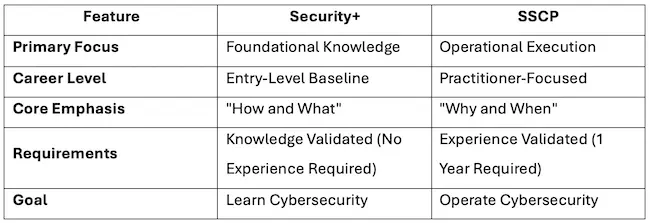
By holding both, you demonstrate real readiness. Security+ proves you have the comprehensive knowledge base, while SSCP proves you have the operational judgment to apply that knowledge effectively under pressure.
Supporting DoD 8140 readiness: Mission-critical standards
For those in the military, DoD civilian roles or government contracting, the combination of these two certifications is particularly powerful. Mission-critical environments require both understanding and execution, and a lack of readiness can have real-world consequences.
Both Security+ and SSCP are DoD 8140-qualified. In the DoD workforce qualification pathways, Security+ establishes the baseline qualification for many entry-level roles. However, as a professional moves into intermediate operational work roles or advanced technical support specialist positions, SSCP becomes the critical operational qualification.
For military personnel, active-duty experience, including network security, system administration and incident response, typically counts toward the SSCP experience requirement. SSCP allows these professionals to bridge their military experience to a globally recognized civilian credential respected across more than 170 countries.
Why employers value both: Signals of growth and credibility
Hiring managers increasingly look for complete operational professionals who have demonstrated a commitment to continuous professional growth. Holding both certifications signals several key traits:
1. Progression from theory to practice: The candidate has successfully transitioned from academic learning to hands-on application.
2. Operational credibility: The SSCP’s experience requirement provides a level of trust grounded in proven on-the-job capability.
3. Proven readiness: The candidate knows how to turn thousands of daily SIEM events into actionable intelligence and communicate risk to technical and business stakeholders.
The complete operational professional: Knowledge + execution
The formula for an effective cybersecurity professional is comprehensive yet simple: Knowledge + Execution = Readiness. Without a foundation, you lack the context to understand the broader mission. Without the operational proof of SSCP, you may freeze when the pressure hits — when alerts escalate at 4:47 p.m. on a Friday and leadership is unreachable.
Security+ builds the foundation. SSCP validates readiness to execute. Together, they form a career advantage that not only defends the organization’s infrastructure but also secures a practitioner’s professional future. By mastering the seven critical domains of operational security, you move beyond being a generalist and become a specialist who thrives under pressure.

Take the next step
- Assess your readiness: Do you have the operational capability to handle real-world pressure? Evaluate yourself across the seven critical domains with the Operational Readiness Assessment.
- Become an SSCP: Learn more about the world’s premier security operations certification: Explore SSCP Certification.
- Learn more about SSCP training: Find the right training path to validate your hands-on expertise and achieve your operational qualification: Explore SSCP Training.