
Cybersecurity is now the price of admission for industrial AI
Industrial organizations are accelerating AI deployment across manufacturing, utilities, and transportation and running straight into a security problem. Cisco’s 2026 State of Industrial AI Report, based on responses from more than 1,000 decision-makers across 19 countries, finds that cybersecurity has become the single largest obstacle to AI adoption, outranking skills gaps, integration challenges, and budget constraints.
The shift is notable. In 2024, cybersecurity ranked third among external growth obstacles. By 2026, 40% of respondents cite it as a top barrier to AI adoption specifically, and 48% name it as their biggest networking challenge overall. The rise reflects the reality that connecting more assets and systems to support AI expands the attack surface in ways that traditional security approaches were not designed to handle.
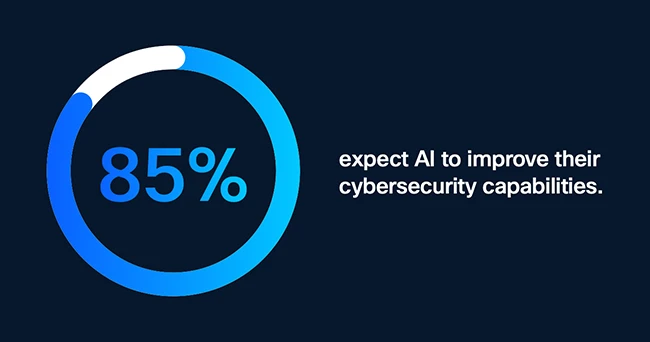
AI as a cybersecurity enabler (Source: Cisco)
Deployment is broad but transformation is limited
Most organizations are not experimenting. According to the report, 61% are actively deploying AI at scale, with the largest group running deployments across multiple sites. Only 14% remain in the exploring or piloting stage.
The drivers remain largely operational. Productivity improvement and cost reduction dominate the motivation for adoption, and 87% of respondents expect to see outcomes within two years. That tight time horizon pushes organizations toward use cases that can demonstrate value quickly, such as process automation and quality inspection.
Network readiness is now a limiting factor
AI workloads are placing demands on infrastructure that most industrial networks were not built to meet. Most decision-makers say reliable wireless networks are vital for enabling AI, and half expect significant increases in connectivity and reliability requirements as deployments scale. At the same time, 48% report that security and segmentation represent their greatest networking challenge, making the infrastructure problem and the security problem largely the same problem.
AI already accounts for 13% of networking budgets, and 83% of organizations plan to increase that allocation. Edge computing capacity, AI vision systems, and industrial connectivity rank among the highest-priority technology investments, as organizations move from human-in-the-loop workflows toward machine-to-machine decisioning.
IT/OT gaps persist and affect outcomes
Collaboration between IT and OT teams remains uneven. Forty-three percent of organizations operate with limited or no IT/OT cooperation, a figure that has not meaningfully improved since 2024. The practical consequences are measurable: 90% of organizations with siloed teams report wireless instability, compared to 61% among those with collaborative structures. Confidence in scaling AI also tracks closely with organizational alignment.
Samuel Pasquier, Product Management Lead for Cisco Industrial IoT Networking, points to discipline gaps rather than motivation as the root cause. “The biggest barrier to IT/OT collaboration is the reality that IT and OT come from very different disciplines, with different technologies, knowledge, priorities, and definitions of risk,” Pasquier said. “Expecting individuals to span both worlds is unrealistic; what matters is enabling collaboration, not convergence of roles.”
When AI systems move from pilots into production, that coordination becomes harder to defer. Where silos persist, Pasquier said, organizations struggle to deploy AI with confidence regardless of how advanced the technology is. Progress is uneven across sectors: the Hi-Tech Electronics and Semiconductor industry leads, with 64% of organizations reporting high confidence in scaling AI, followed by energy and transportation. Parts of Europe are also moving faster, where leaders are framing AI as a shared operational capability.
Only 20% of organizations report fully collaborative IT/OT interworking on cybersecurity. That gap matters for how risks are perceived. The report notes that more collaborative organizations are actually more likely to cite cybersecurity as a primary obstacle, at 12 percentage points higher than those operating independently. The report attributes this to visibility: closer collaboration surfaces risks that siloed teams may not detect.
AI is also part of the security answer
Despite cybersecurity’s role as a constraint, organizations are betting heavily on AI to strengthen their defenses. Eighty-five percent of respondents expect AI to improve their cybersecurity posture, and industrial cybersecurity ranks as the second most important area for AI investment overall. The expectation is that AI will improve detection, monitoring, and response at a scale and speed that manual approaches cannot match.
For manufacturers still operating on legacy infrastructure, Pasquier said the path forward does not require replacing existing systems. The first priority is visibility. “You cannot protect or feed data to an AI if you don’t know what’s on your wire,” he said, adding that visibility needs to extend beyond north-south communication all the way to the network edge to capture east-west traffic between devices, with network telemetry as the most practical mechanism. The second step is network segmentation to ring-fence AI workloads so that a security event on the office network does not reach the plant floor. Third is moving toward unified IT/OT governance, treating OT cybersecurity as a shared baseline.
The report’s outlook for the next three to five years reflects both confidence and caution. Ninety-three percent of organizations are confident in their ability to scale AI, yet only one-third expect enterprise-wide operational transformation over that period. Most continue using AI to improve existing processes rather than redesign how operations work.
The gap between confidence and transformation is where infrastructure, security, and organizational structure intersect. Organizations that are furthest along in AI deployment share a common profile: modernized networks, mature cybersecurity practices, and collaborative IT/OT governance. Those conditions are not yet widespread, and until they are, AI at industrial scale will remain the exception.