
Global fraud losses climb to $442 billion
Online fraud is reaching more victims and generating larger losses, driven by digital tools and organized networks operating across borders.
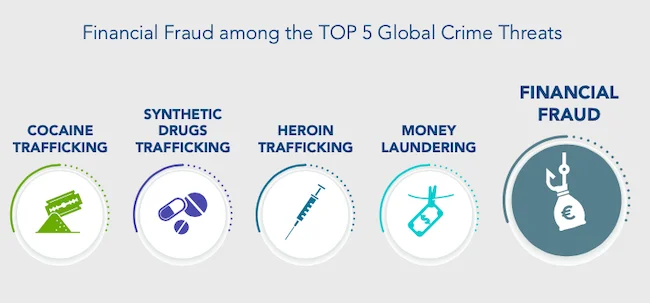
Global trends in financial fraud (Source: Interpol)
In INTERPOL’s March 2026 Global Financial Fraud Threat Assessment, financial fraud sits among the top five global crime threats, with a 54% rise in fraud related Notices and Diffusions from 2024 to 2025.
“Estimating the financial cost of fraud is challenging for a number of reasons, including significant levels of under-reporting. However, a range of data points indicate that the cost is very high and growing. For instance, one estimate suggests that global losses in 2025 totaled $442 billion,” INTERPOL noted.
Scam centres are scaling and spreading
Scam centres have moved beyond a regional issue and are operating on a global scale. INTERPOL has monitored this model since 2022. By late 2025, trafficked victims came from nearly 80 nationalities, up from 66 in the first quarter of 2025.
Once concentrated in Southeast Asia and sourcing victims mainly within the region, these operations have expanded to include victims from South America, Western Europe and Eastern Africa, with new centres reported in the Middle East and North Africa, Central America and West Africa.
Fraud tied to these centres includes investment scams, romance baiting, cryptocurrency and Forex frauds, impersonation schemes and unauthorized online gambling.
AI is changing how fraud is carried out
AI and digital tools have changed social engineering and victim profiling, making schemes more convincing and easier to deploy. LLMs, cryptocurrencies and Fraud-as-a-service (FaaS) platforms have lowered the barrier to entry, supporting the growth of fraud as a global industry.
AI systems can carry out entire schemes, from targeting victims to generating tailored ransom demands, while synthetic identity kits on dark web marketplaces enable the creation of voice and video clones using as little as 10 seconds of audio.
Criminal networks also rely on phishing kits, fake trading platforms, AI chatbots and integrated laundering services. Investigators believe AI-enabled fraud schemes are about 4.5 times more profitable than those without AI.
Reports of financially motivated sextortion have increased over the past two years in all regions, with AI playing a central role in its spread.
GenAI allow fraudsters to create explicit content and target individuals using publicly available images, making execution easier and expanding the pool of potential victims.
Regional trends show sustained increases
INTERPOL has carried out several successful operations in Africa in recent months, resulting in significant losses for criminal groups. Operation RED CARD 2.0, conducted between 8 December 2025 and 30 January 2026 in 16 African countries, resulted in 651 arrests and 2,341 electronic devices seized.
The Americas and the Caribbean recorded a 40% increase, with one case involving a Massachusetts-based workers’ union that lost $6.4 million in a business email compromise scheme, with funds traced to seven U.S. bank accounts.
Asia and the Pacific recorded a 47% increase, with Operation HAECHI VI resulting in 32,835 arrests, 68,000 bank accounts blocked and $439 million recovered, including $342 million in government-backed currencies and $97 million in physical and virtual assets. Europe recorded a 69% increase, the highest among all regions.
“As digital technologies become increasingly central to how we live and work, opportunities for fraud have expanded, making it a shared challenge for individuals, businesses and governments worldwide,” said Valdecy Urquiza INTERPOL Secretary General.