
Nearly half of open-source AI projects never reach production
Open models are moving into production across more organizations, and the work of securing those deployments increasingly extends beyond the model weights. Mozilla’s The State of Open Source AI 2026 identifies deployment, governance and operational tooling as persistent obstacles as model capability improves.
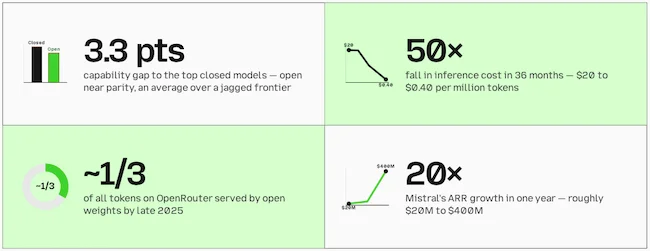
Open source AI in 2026, in four numbers. (Source: Mozilla)
“Without investment in the infrastructure, tooling, and governance around open models, we risk locking in a system where only restrictive, closed AI can scale – and that doesn’t serve the public interest, or sovereignty over tech policy decisions,” said Raffi Krikorian, Mozilla’s Chief Technology Officer.
The capability gap between leading open and closed models has narrowed to an average of 3.3 points on Chatbot Arena, giving organizations a wider choice for production workloads. The average hides differences across tasks: open models are at or near parity in coding, instruction-following and general knowledge, while closed models retain an edge in reasoning, long-context retrieval and agentic tasks.
The price of the cheapest model offering GPT-4-class performance fell 50-fold over 36 months, from about $20 to $0.40 per million tokens. This measure uses blended API list prices and does not represent every inference workload.
Open-weight models accounted for about one-third of all tokens routed through OpenRouter by late 2025. The figures cover routed traffic and exclude first-party services such as ChatGPT and Gemini.
Deployment continues to lag adoption
79% of developers use open models, and 89% of organizations use open components somewhere in their software stack.
Just over half of organizations using open models have moved them into production. Closed models continue to reach production more often, indicating that deployment barriers extend beyond model capability.
Deployments completed with vendor partners reach production more frequently than internally developed implementations. Mozilla identifies operational tooling and organizational trust as the primary factors separating experimentation from production use.
Community support, ease of adoption and model capability receive stronger scores than standardization and enterprise readiness. The weakest results appear in safeguards, where governance, operational consistency and production maturity trail other parts of the ecosystem.
Organizations don’t spend most of their evaluation effort deciding which model to use, they integrate them into production environments that meet operational and security requirements. Small organizations recorded similar production rates for open and closed models. The difference widened among mid-size and enterprise adopters. Additional staff and infrastructure coincided with higher production rates for both model types, and the open deployment rate remained below the closed deployment rate in each larger group.
Companies need hosting, maintenance, integration, support and controls that fit their own systems.
Security and operations drive deployment friction
Developers identified infrastructure costs as a challenge, although security, privacy and compliance followed closely behind. Maintenance, deployment complexity and system integration also ranked as the most common operational concerns.
Developers who stopped using open models reported these operational issues more often than developers who continue using them. Maintenance requirements and integration challenges showed the largest increases, suggesting that production operations are a significant source of friction after initial experimentation.
The harness becomes the next control layer
Mozilla describes the agentic harness as the next major development layer. It includes orchestration, tools, memory, execution environments, permissions, identity, evaluation, observability and governance.
The harness has become the primary area where organizations differentiate production deployments. Model weights improve and become more widely available, the surrounding software determines how models are governed, monitored and connected to other systems.
Model evaluation often focuses on capability, accuracy and benchmark performance. Production deployments introduce further requirements, including identity, permissions, auditability, budget controls and operational oversight across multiple AI components.
