
INTERPOL flags AI as the new engine of African cybercrime
Africa’s growing digital economy is exposing governments, businesses and internet users to a rising wave of cybercrime. The continent recorded more than 1.1 billion mobile subscriptions and over $1.1 trillion in digital transactions in 2025, while more than 570 million people relied on the internet for banking, government services, healthcare and education.
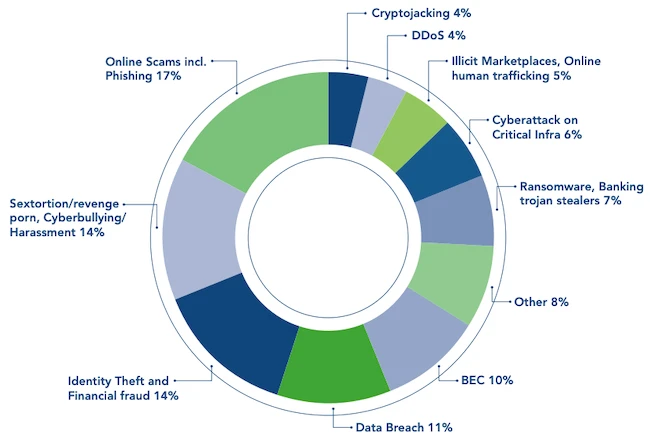
Reported cybercrime cases by type in 2025 (Source: INTERPOL)
Cybersecurity infrastructure, regulation and institutional capacity have not kept up with digital growth, according to INTERPOL’s African Cyberthreat Assessment Report 2026.
“Cybercrime has emerged as one of the most significant criminal threats to the region. AI is automating every stage of a cyberattack from reconnaissance and phishing to extortion and evasion,” Neal Jetton, Director of INTERPOL’s Cybercrime unit, said.
Cybercrime spreads across Africa
Respondents in parts of West and Southern Africa estimated that cybercrime accounted for more than 30% of recorded crime in 2025. Reported cybercrime-related losses rose to $484 million from $192 million a year earlier, while the number of identified victims increased from 35,000 to 87,000. The report said inconsistent national reporting made a comprehensive total difficult to establish.
Financial-services companies, telecommunications providers and government institutions were among the sectors most affected. Criminal networks exploited differences in national laws, limited cross-border cooperation and shortages of trained investigators to operate in multiple countries.
Cyber threats varied across the continent. East Africa was a hub for mobile-money fraud and infrastructure-targeted ransomware. West Africa recorded the most business email compromise detections and widespread online scams. Southern Africa experienced the heaviest concentration of ransomware, phishing and distributed DDoS attacks. Central Africa saw rising botnet activity and social engineering attacks.
How cybercriminals attack
Ransomware attacks disrupted essential services, including weather systems, customs operations, electricity networks and telecommunications providers. South Africa accounted for 92% of African ransomware detections recorded by TrendAI in 2025. Nigeria, Uganda and Namibia reported suspected or confirmed attacks affecting critical infrastructure and public services.
Online scams were the most reported form of cybercrime. Mobile-money fraud, phishing, fake loan apps, cryptocurrency investment scams and romance scams were often linked to organised criminal networks operating across national borders.
Business email compromise caused financial losses through compromised accounts and deceptive emails, including AI-generated correspondence designed to imitate executives and persuade employees to redirect payments.
Data breaches supplied personal information and credentials that criminals used for identity fraud, account takeovers and further attacks. Criminals combined real and fabricated information to create synthetic identities capable of bypassing identity checks, opening bank accounts, obtaining mobile loans and registering SIM cards under false names.
Gaps in cybercrime response
Many African countries struggle to address cybercrime because of gaps in laws, resources and cross-border cooperation. Differences in legal systems make it difficult to investigate cases spanning several countries, share digital evidence and prosecute offenders.
Law enforcement agencies lack funding, specialised personnel and digital forensic tools, limiting their ability to investigate deepfakes, synthetic identities and other AI-assisted attacks. The report found that 92% of surveyed agencies cited a lack of technical expertise as the main barrier to adopting AI tools.
Cooperation between law enforcement agencies, technology platforms, telecom providers, banks, fintech companies and mobile-money operators is limited. Delays in information sharing and differences in legal procedures allow criminal networks to move money, data and operations between countries.
At the same time, governments across the continent are strengthening their response. In 2025, several countries updated cybercrime laws, expanded specialist training and launched public awareness campaigns. Regional operations led to hundreds of arrests, the seizure of thousands of devices and the disruption of ransomware, fraud and online scam networks.
