
The hardest part of agentic AI may be rebuilding the business
Organizations expect AI agents to change how work gets done, driving productivity and growth while allowing employees to focus on higher-value tasks. Few, however, have the processes and workflows needed to realize those benefits, according to Deloitte’s latest research.
Preparing the operating model for AI agents
About half of surveyed leaders say they understand how AI agents will affect their future operating model. Three main challenges limit wider adoption: the lack of a unified and accessible data foundation, limited trust in and governance of AI agents, and the cost and complexity of integration.
AI adoption also remains constrained by issues related to data, decision-making, governance, organizational design, workforce readiness, and costs. Fewer than half of surveyed leaders say their organizations are prepared for agentic AI across most areas of the business. Workforce readiness and business processes rank as the weakest areas, indicating that organizations still need to develop new ways of working with AI agents.
“AI transformation includes moving beyond one-off fixes to a sustained focus on improving work outcomes. Limited, layered-on approaches may create the sense of getting ahead with quick wins, but in reality, they may not be enough,” said Laura Shact, U.S. Technology, Media and Telecommunications (TMT) AI growth leader at Deloitte.
“Thriving in the agentic future will require more. True transformation asks for more than just alignment with technology and data strategies, but also investments in work and organization design, as well as intentional leadership and workforce enablement.”
Leaders expect AI agents to change business processes and the workforce over the next four years. They anticipate processes being redesigned around the technology to support real-time decision-making and greater autonomy, while agents work across business functions to complete complex, multistep tasks with people primarily providing oversight.
Redesigning processes around AI agents
Only 16% of leaders say their organizations’ processes are ready for agentic AI, with just 5% describing them as highly prepared. Even for organizations that have deployed AI agents at scale, readiness remains limited, with 46% reporting that their business processes are prepared.
Executives and AI and data science leaders attribute the lack of readiness to poorly documented processes, fragmented data and systems, entrenched ways of working, and limited AI expertise among executives and employees. Only one in five say their organizations are prepared to redesign business processes to operate autonomously with AI agents.
Many organizations are introducing AI agents into existing workflows instead of redesigning processes from the ground up. This layered approach may offer a quicker path to short-term payback while helping organizations build experience and credibility with the technology.
Long-term value is expected to depend on redesigning business processes around AI agents, a transition likely to take several years. About 31% of surveyed organizations expect at least half of their business processes to be redesigned or rebuilt around AI agents within two years. The figure rises to 74% over the next four years.
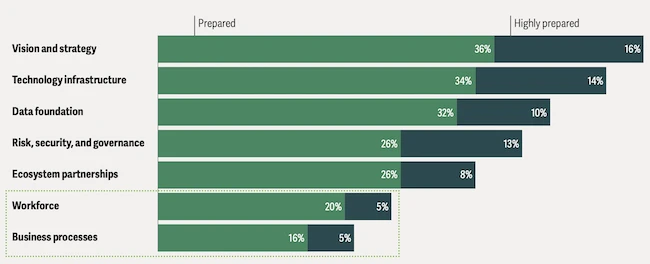
Few organizations say their business processes and workforce are ready for agentic AI (Source: Deloitte)
Job disruption is expected to accelerate
Business leaders anticipate changes to job requirements, training needs, roles and how employees work with AI. About 43% expect a lot to extreme job disruption within the next 12 to 18 months.
Executives expect routine and structured tasks to become automated, while creative, strategic and high-judgment work will continue to require human involvement. Employees may direct AI agents, review their output, validate quality and determine when human judgment is required.
Organizations are preparing workers for this shift through AI literacy programs and targeted training for roles likely to be affected. About 71% report providing baseline AI-agent literacy training, while 65% are targeting upskilling or reskilling toward roles expected to grow or change because of agentic AI.
Half of surveyed leaders say their organizations are not investing enough in the workforce changes needed to support AI agent adoption. Rising infrastructure and usage costs can add pressure as companies allocate resources between technology and workforce investments.
Governance will play a key role in defining these working arrangements, including which decisions agents can make, when people should intervene, who is responsible for outcomes and how tasks move between employees and AI agents.
