
Cybersecurity job ads demanding AI skills double in a year
Job postings asking for AI skills in cybersecurity have doubled in a single year in G7 countries according to new research from the Cisco-founded AI Workforce Consortium.
Analysis from recruitment firms Cornerstone and Indeed covering 24 months, from April 2024 to March 2026, spans G7 markets. It found that 28.5% of cybersecurity job postings between October 2025 and March 2026 required AI skills, up from 14.2% in the same period a year earlier.
An “agentic skill stack” is settling in as the baseline for high-volume roles such as security engineering, cloud security, and detection and response engineering. Five skills show up again and again in AI-tagged postings: Python, prompt and context engineering, AI security, agent orchestration, and machine learning operations.
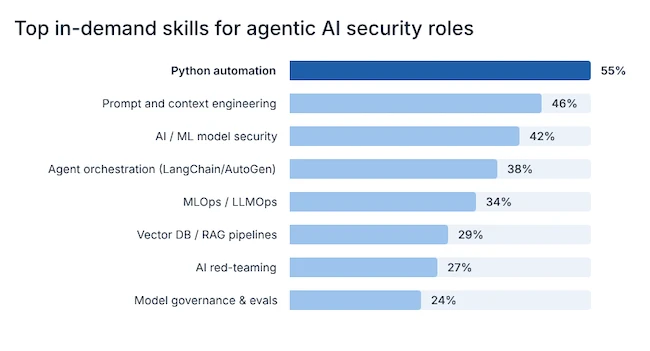
(Source: Cisco)
Salary data from Lightcast, covering the same six-month window in the US, put the median advertised pay for AI-skill postings 14.9% above the median for cybersecurity postings overall.
Same job title, different work
Security Engineer and Cybersecurity Engineer/Analyst remain the two most commonly listed roles in G7 cybersecurity postings, at 18% and 16% of the total, followed by SOC Analyst at 12% and Cloud Security Engineer at 9%.
AI systems are absorbing the high-volume, repetitive parts of the SOC analyst job: triaging alerts, correlating threat intelligence feeds, and running standard decision-tree workflows. Omar Santos, a Distinguished Engineer at Cisco, described this on the report’s expert panel as one of the fastest-reshaped jobs in the field, with the analyst becoming more of an orchestrator than a processor of alerts.
“AI agents are approaching human-level performance in some domains and surpassing it in others,” the report says, though it argues human proficiency in the domain stays essential regardless. Nobody can check a machine’s reasoning about a packet capture without knowing how to read one. What’s new on top of that foundation is agent supervision, output validation, and handling the exceptions automation kicks up.
Postings asking for ethical reasoning grew 533% year-over-year. Stakeholder engagement grew 125%. Asked what matters most for entry-level workers by 2030, over half of the security leaders Cisco surveyed named securing autonomous AI systems as the top skill, and half named a strong technical foundation paired with the ability to keep learning.
The AI forensics expert, a role barely on the market three years ago, investigates AI systems after they fail or cause harm, working with training data and prompt histories instead of a disk image. The job title “digital forensics analyst” grew 453% in the period studied, the fastest of any role tracked, though the total number of postings is still small.
Fewer openings for people starting out
Cybersecurity job demand in G7 economies grew 9.5% in the six months ending March 2026, up from 6.8% growth in the prior six months. Senior-titled postings grew 65.0% in the same window, after growing 46.1% in the six months before that.
Junior-titled postings moved from a 0.6% decline to 5.9% growth over the same two windows. Senior titles still make up a small share of the market overall, about 6.7% of all G7 cybersecurity postings against 0.7% for junior titles.
Cisco surveyed 8,000 security leaders in 30 markets and 14 industries in May 2026 and asked which competencies are hardest to find in entry-level candidates. Three came back close together: hands-on experience with AI agents (49%), technical cybersecurity depth (48%), and human-centric professional skills (45%).
The report frames this as an experience paradox: employers are asking for senior-level skills even in roles labeled entry level.
