
Microsoft’s Project Zenith puts large AI models directly on developer PCs
Microsoft’s Project Zenith is a ready-to-code Windows 11 experience for developer-class PCs capable of running AI models with more than 30 billion parameters locally without relying on metered cloud tokens. Designed for systems with at least 64 GB of unified memory and 250 GB/s or more of memory bandwidth, it pairs powerful hardware with a preconfigured software environment for coding, testing, and experimentation.
The first Project Zenith systems will be powered by AMD Ryzen AI Halo, with additional devices from OEM and silicon partners expected in the coming months.
The devices will benefit from ongoing Windows 11 improvements to performance, reliability, Search, File Explorer, and memory usage.
A preconfigured development environment
Project comes with preinstalled tools spanning programming languages and runtimes, source control, and productivity. Windows Terminal and Visual Studio Code are pinned to the Taskbar by default, providing immediate access to key development tools.
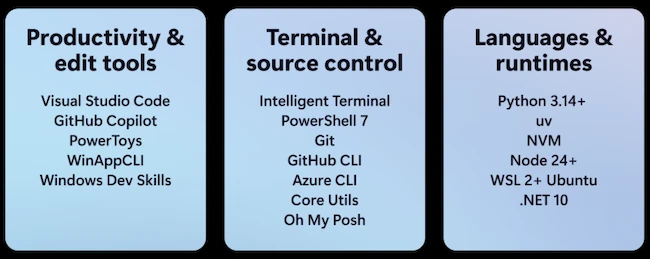
Preinstalled tools (Source: Microsoft)
Windows is also preconfigured for development. File Explorer displays file extensions, hidden files, the full path in the title bar, and the details pane, while support for long paths is enabled. Recently used files and folders and sync provider tips are turned off for a cleaner workspace. In Search and Start, Command Palette is enabled, while Start menu tips and account notifications are disabled to reduce distractions.
Windows Subsystem for Linux (WSL) provides a foundation for running Linux workloads on Windows. WSL containers provide a built-in way for developers to create, run, and interact with Linux containers directly on Windows.
Developers can continue to configure and personalize the environment with the tools, languages, and frameworks that fit their workflows, while starting from a development-focused baseline.
Built-in security for AI agents
Windows provides security features for AI agents, including OS-enforced identity, containment through Microsoft Execution Containers (MXC), and enterprise-grade manageability for agents. These platform protections will be available on Project Zenith devices from day one.
Developers can use local models for everyday tasks and turn to cloud models for more demanding workloads, helping reduce cloud usage and token costs.
“Project Zenith also reflects how Windows moves forward with our ecosystem. By working with our OEM partners, we give developers choice across devices and performance tiers while preserving the ready-to-code experience. The hardware may vary, but the developer promise is consistent – powerful for modern development, thoughtfully configured and ready for developers from the start,” Logan Iyer, Corporate Vice President, Windows Platform + Developer at Microsoft, explained.
