ShinyHunters-linked crew resurfaces on new leak site
The ShinyHunters leak site went dark in September, but a crew that supplied it with victims seems to have found a new home under the “Inception” name, Okta’s threat intelligence team has discovered.
Okta tracks the crew as O-UNC-053, a cluster that has been running social engineering and credential-harvesting campaigns since March 2026. Its targets include companies in technology, healthcare, biotech, financial services, insurance, entertainment, gaming, retail, transportation, hospitality and the legal sector.
“While this threat cluster has changed their brand affiliation, the operators remain active in targeting organizations with voice phishing attacks and account takeovers resulting in data theft and extortion,” Okta threat hunters Moussa Diallo and Katie Nickels wrote.
Between March and September, O-UNC-053’s victims turned up on the ShinyHunters leak site one to 28 days after the gang registered phishing domains to target them. Okta reads that as a sign of a significant relationship, possibly an agreement, though the leak site almost certainly took victims from other intrusion crews as well.
Then came two arrests of alleged ShinyHunters affiliates, on September 15 and 29, and the leak site went offline.
O-UNC-053 kept registering phishing domains through October and early November, with nowhere obvious to post its victims. A legal-themed campaign started in late October, and on November 16 Inception appeared, listing organizations the gang had registered domains for six to 19 days earlier.
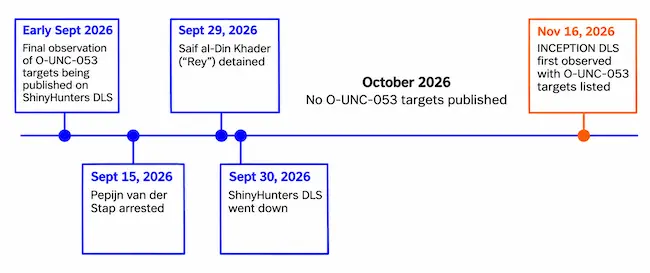
O-UNC-053 key events from September through November 2026 (Source: Okta)
“This gap in publishing on any leak site followed by publishing on a new data leak site with a new brand is consistent with prior shifts from Com-affiliated actors. Before and after the change in DLS publication, O-UNC-053 maintained consistent infrastructure and TTPs, leading us to assess that the cluster has very likely changed their brand affiliation,” the pair added.
The FBI describes The Com as a largely English-speaking, international network of mostly young cybercriminals with thousands of members and a hacking branch it calls Hacker Com.
“Members of Hacker Com typically have a shared interest, ideology, or goal and work together, adding others to the group and splintering when necessary, to achieve their mission,” the bureau said.
Okta stops short of saying O-UNC-053 runs Inception, and allows that the crew may simply be working with another extortion outfit.
ReversingLabs on the same trail
ReversingLabs published separate research linking Inception’s extortion claims to a vishing operation targeting single sign-on accounts. Within five days of its launch, the site claimed AMD, Cigna Healthcare, Henry Schein, Paychex, PepsiCo, AutoZone and Lucid Motors as victims, though ReversingLabs stresses that none of these claims have been verified.
“Rather than relying on traditional email lures, this operation is using voice phishing (vishing) to compromise single sign-on (SSO) credentials. Technical analysis of the adversary’s domain infrastructure directly corroborates this out-of-band delivery model. None of the legal-themed lure domains tied to the campaign possess MX records, DKIM, DMARC, or any other email-related DNS configurations,” explained Robert Simmons, principal malware researcher at ReversingLabs.
Most of the kits mimic the target’s Okta sign-in page, though the one built for Lucid Motors copies a NetIQ/OpenText Access Manager login, which tells you the crew checks each target’s SSO setup before dialing.
“The core of this campaign relies on tailoring the landing page to the specific identity provider of the target. All the domains in the confirmed cluster are configured to filter unwanted visitors and forward them to the victim’s legitimate authentication infrastructure,” Simmons noted.
The company has also spotted lure domains for dozens of businesses that haven’t appeared on the leak site so far, among them Activision Blizzard, Riot Games, Starbucks, Nintendo and Paramount.
“Because this adversary targets the identity layer rather than endpoints, defenders must prioritize phishing-resistant authentication across all identity providers, enforcing FIDO2 security keys, passkeys, or origin-bound authenticators alongside managed device restrictions and alerts for unexpected MFA changes,” Simmons advised.