Credential harvesting goes from fringe activity to major exploitation trend
Requests to steal credentials made up 13% of all vulnerability exploitation recorded between January and November 2026. Their monthly share climbed from about 1% in January to between 25% and 35% in September and October, data from VulnCheck’s canary network shows.
The company tracked 694 exploited CVEs during those eleven months. Attackers used 127 of them (18%) at least once to go after database passwords, cloud keys, API tokens or SSH keys.
“Credential harvesting has become a core part of how attackers exploit vulnerabilities,” wrote Patrick Garrity, a security researcher at VulnCheck.
Laravel and .env files top the list
Application secrets were the most popular target. Laravel secrets drew requests from 4,784 distinct IP addresses, .env files from 2,840 and process environment variables from 2,341. Cloud credentials came next, with AWS keys sought by 1,687 IPs and Google Cloud credentials by 1,007.
Open source software, AI products and developer tools account for 77 of the 127 CVEs, while network edge devices account for only 10. The flaws are recent, with 57% carrying 2025 or 2026 IDs.
A sixfold jump in four months
Between July and October, monthly harvesting records grew from about 17,000 to 99,000. Scanning first focused on CVE-2025-30208, a file-read flaw in the Vite frontend tool, in August and September. It then shifted to CVE-2025-29927, a Next.js middleware bypass that produced 68,000 of October’s 99,000 records.
September’s peak share of 34.5% came partly from a drop in React2Shell exploitation that month while harvesting kept growing.
Lower scores and a bigger share
The median CVSS score of the vulnerabilities used for harvesting is 9.4. Medium-severity bugs made up only 6% of the list but produced 23% of all harvesting records. They include a Laravel log disclosure flaw (CVE-2024-29291) and a Mailpit SSRF bug (CVE-2026-21859), both rated 5.3.
File-read and SSRF flaws do not require code execution. With these bugs, Garrity explained, attackers can read secrets off a server without running anything on it.
Thieves add AI keys to the haul
VulnCheck first saw attackers hunting for AI credentials in May 2026, and the activity has turned up every month since. In total, the company recorded 1,756 attempts from 406 unique IPs, tied to 27 CVEs.
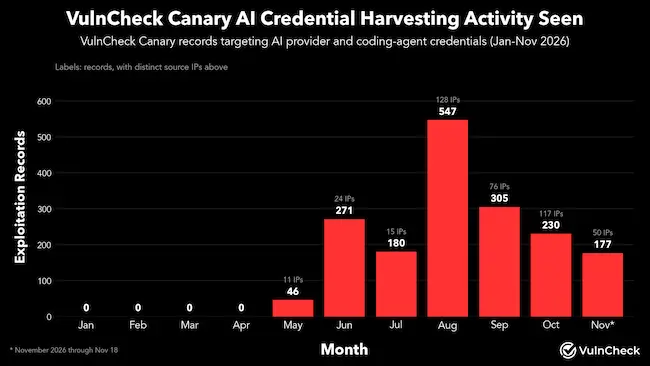
OpenAI keys drew 1,085 attempts and Anthropic’s Claude keys 778, ahead of Hugging Face (317), Google Gemini (271) and Groq (153). DeepSeek, Mistral and OpenRouter keys were also on the list. Some attackers asked servers for config files. Others searched environment variables after getting code execution or scanned file systems for key prefixes such as “sk-ant-” and “sk-proj-“.
Credential files for coding agents like Claude Code, OpenAI Codex and Cline came up too, though each was targeted by five or fewer IPs.
AI key hunting starts sooner after a flaw is first exploited. Attackers exploited older Langflow and Vite bugs for months before they started looking for AI keys through them. For most CVEs first exploited after mid-2026, that hunt followed within days or weeks, and for newer Langflow and AutoAgent bugs within a week.
“Credential harvesting rides on a small set of very recognizable exploit patterns. Alert on path traversal through static and asset prefixes. Most of these hit internet-facing apps that rarely see legitimate requests like this, so a single hit is worth investigating,” Garrity noted.