
The scam economy has found its AI upgrade
Scam attempts continue to reach consumers via email, text messages, social media, online advertising, and phone calls. The volume of exposure has remained stable over the past year, with more than half of consumers encountering scam attempts at least monthly, according to the F-Secure Scam Intelligence & Impacts Report 2026.
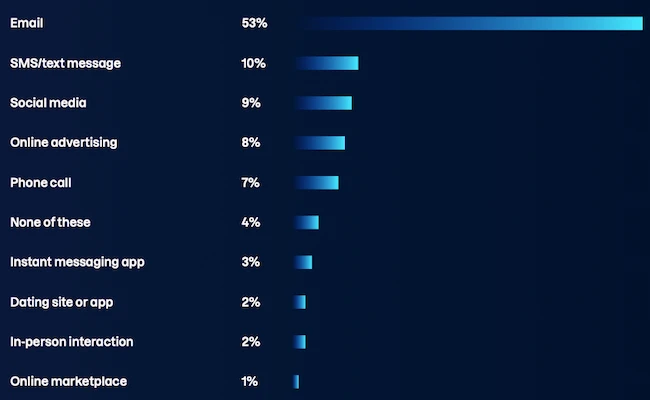
Most common channels for scam attempts (Source: F-Secure)
The United States recorded the highest exposure levels among surveyed markets. Younger consumers reported higher scam activity than older age groups, linked to heavier digital activity through multiple platforms.
Email remained the most common scam channel globally. Younger consumers encountered scam attempts across a wider mix of SMS, online advertising, and social media. Older consumers experienced a narrower threat environment, with phone calls remaining one of the leading channels after email.
“Scams are getting so much more efficient. When you look at this data, it’s important to remember that each statistic is a real person who has lost money, confidence, or peace of mind,” said Dr. Megan Squire, Threat Intelligence Researcher at F-Secure.
Scams aimed at direct payments dominate
Fraud tied directly to financial transfer accounted for a large share of reported activity in 2026. Fake invoice and debt schemes, investment fraud, and banking or payment scams represented half of reported attempts. Fake invoice scams showed the largest year-over-year increase.
Differences in digital environments affect victimization rates. Age is another factor, since younger generations reported higher victimization rates.
More than half of victims reported losing money in 2026, more than double the level reported in 2025. Lost time, stress, data loss, and reputational damage were reported less frequently. Older victims were more likely to lose money once targeted. Consumers aged 65 to 74 recorded the highest rate of monetary loss among victims.
Willingness to pay for scam protection may be influenced by cultural factors. The research shows that individual security behavior is influenced by digital maturity, institutional trust, and cybersecurity culture.
Users consider cybersecurity an important part of service offerings and say they would switch providers based on security features.
AI tools create new scam opportunities
Fraudsters are experimenting with poisoning the data AI systems rely on and influencing responses from LLMs. User behavior has moved toward using AI assistants as search tools, opening new opportunities for manipulation.
Internal testing found that ChatGPT returned fraudulent airline customer service numbers during a major winter storm in the United States that caused over 5,000 flight cancellations. Researchers said the same manipulation methods could be applied to any search for customer support or technical assistance.
AI-powered shopping tools create another risk point. Recommendations from AI assistants can make fraudulent merchants appear trustworthy at the moment clients are ready to buy products online. In one test, ChatGPT repeated a fake store’s claim that it was “going out of business,” repeating the urgency messaging used on the merchant website.
Generated content is changing the quality of online fraud. Fraudsters are using automated tools to produce polished messages, convincing visuals, and synthetic voices. Internal threat research found that 89% of scammers’ AI use focused on improving scam bait and making scams harder to identify.
Public concern around AI-generated deception is growing. 84% of respondents said they worry AI will make it impossible to tell what is genuine online.
