
Codex knowledge work expands into research, reports, and spreadsheets
Office workers in the United States lose hours each week to email triage and to searching for files spread across disconnected systems. Roughly 40 percent of US labor, about 72 million people, works primarily with information such as analysis, documents, designs, and communication. Research from the McKinsey Global Institute puts the average knowledge worker at 28 percent of the workweek on email and close to 20 percent on hunts for internal information or for colleagues who can help with specific tasks.
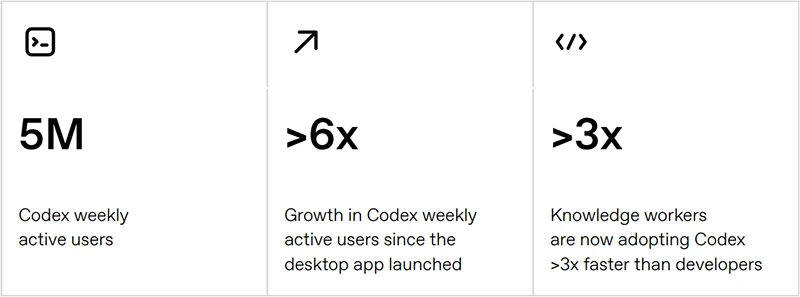
Codex, the agentic coding product from OpenAI, has reached 5 million weekly active users, more than six times the level recorded when its desktop app launched in February.
Knowledge workers now account for about 20 percent of those users and are adopting Codex more than three times as fast as developers. Personal users sit above 5 percent of the base and are growing more than four times as fast as developers, with use clustered in hobbies, education, self-learning, personal finance, and entertainment.
Task mix moves past code
Each week, 72 percent of knowledge worker users produce artifacts such as reports, memos, contracts, images, audio, video, PDFs, and spreadsheets. Engineering operations cover 47 percent of weekly use, code implementation 46 percent, application management 42 percent, and research 41 percent. The boundary between software work and other knowledge work has thinned. Product managers build their own dashboards. Researchers write dataset-cleaning scripts directly. Designers ship prototypes without a developer in the loop. Executives put together internal tools that reconcile files and produce weekly reports.
Data analysis leads weekly growth
Among knowledge workers, data analysis is growing 110 percent week over week. Research follows at 37 percent, and knowledge artifacts at 36 percent. Within knowledge artifacts, users working with PDFs and spreadsheets have grown more than 50 percent. Market research into companies, industries, competitors, and market sizing accounts for much of the research growth.
Data labeling dominates data analysis tasks, with the majority of usage and the fastest growth rate. Other categories posting more than 40 percent growth include drafting messages, building and designing products, understanding contracts, regulations, and policies, and hiring and interviewing.
Parallel tasks become routine
About 50 percent of Codex users now keep more than one task running at the same point in a given day. The proportion stood below one third in mid-April. The shift lets a single user inspect a dataset on one thread, draft a script on another, assemble a report on a third, and check an application on a fourth. The user becomes the orchestrator of workstreams.
Case studies span government data, sales, teaching, and personal projects
GroundVue uses Codex to make public meetings from roughly 90,000 government bodies searchable and comparable. The company collects scattered video, web, and platform sources and turns them into structured records. Tasks that took days or weeks now take minutes, allowing a small team to perform work that previously would have required large groups of technologists and researchers.
Proaction, a five-person fleet management startup, uses Codex during sales. Co-founder Colin Knudsen turns customer conversations into customized proposals, workflow prototypes, and working demos before any contract is signed. The setup links customer discovery, sales, and product development inside a small team.
Mathematics professor Taiyo Inoue at California State University uses Codex to generate scripts that update assignments, calendars, materials, and announcements in the Canvas learning management system. By his estimate, the workflow saves four to five hours each week, time he applies to in-person problem-solving sessions with students.
Luke Xing built a desktop application with Codex to compensate for major and variable hearing loss in his left ear. The app tests hearing across frequencies and adjusts audio output for different devices. The tool serves personal use and sits outside medical-device categories.
Policy recommendations
Four policy directions from OpenAI accompany the data. Public agencies should deploy agents to cut administrative backlogs, reconcile records, support scientific research, and speed up public services, with success measured in wait times, permitting speed, benefits delivery, and administrative cost. Governments should fund hands-on AI training through schools, community colleges, public agencies, libraries, and employer partnerships.
Worker-led adoption should be supported through small-business grants, public-sector innovation funds, technical assistance, and channels for workers and managers to guide how AI gets used. Public procurement should be updated so agencies can buy AI tools tied to operational outcomes, with privacy, security, auditability, and human oversight required for pilots.

Download: Secure Foundations for AI Workloads on AWS