Android adds AI-powered scam alerts, hangs up on bank impostors
Google’s new scam protections cover Google Messages and third-party messaging apps, with an enhanced protection mode, expanded scam alerts and safeguards against call-forwarding and screen-sharing scams.
“With scams growing harder to spot, it’s nearly impossible for users to catch every red flag themselves. That’s why Android’s built-in defenses actively intercept these threats before they reach you,” Alberto Pastor Nieto, Senior Product Manager at Google Messages, and Shaifali Bhandari, Product Manager at Android, explained.
Scam alerts and link checks
Enhanced protection in Google Messages will roll out in the coming weeks as an opt-in setting. It includes Scam Detection enhanced with Private AI Compute, which uses cloud-based Gemini models to assess message context and identify scammers’ intent during conversations with unknown senders. According to Google, Private AI Compute encrypts data and processes it in a secure, dedicated space, keeping it inaccessible to anyone else, including Google.
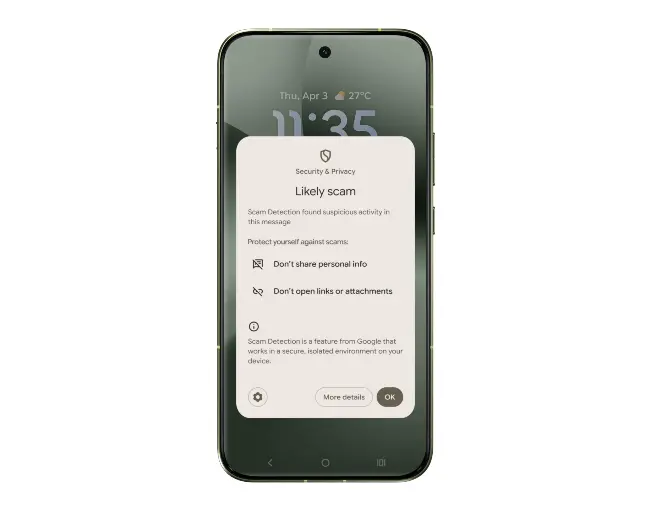
With Enhanced protection enabled on supported devices, on-device Gemini Nano uses real-time web signals to assess unfamiliar links before users click them, building on existing checks for known malicious and phishing websites.
Enhanced protection provides redesigned warnings that give users more time and context before opening links from numbers outside their contacts. These warnings were previously available in select countries or on devices with Android Advanced Protection enabled.
Google is working with Android device makers to expand Scam Detection in chat notifications beyond Pixel devices later this year. The feature flags suspicious messages in the notification shade before users open a supported messaging app.
Blocking data theft and spoofed calls
Android is extending its screen-sharing protections from native apps to Chrome and Android WebView. The feature blanks out login fields and payment screens during live screen-sharing sessions. The expansion is rolling out this month to devices running Android 15 or later.
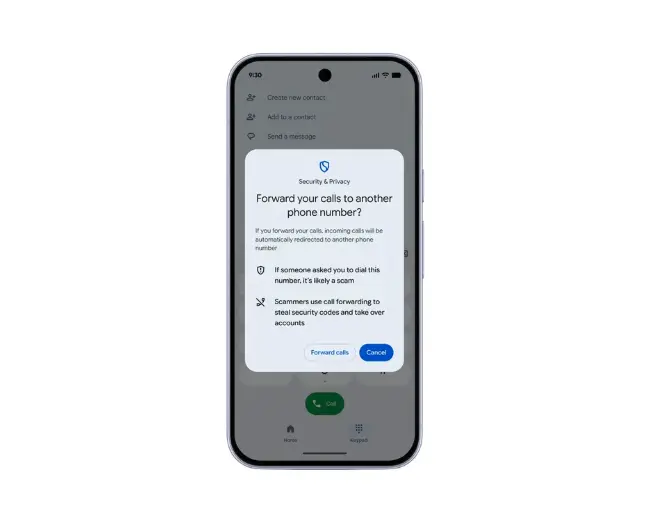
To help prevent scammers from intercepting one-time passwords and taking over accounts, Android will block apps from enabling call forwarding in the background. If a scammer persuades a user to enter a man-machine interface (MMI) forwarding code on their phone’s dial pad, Android will display a warning before the code takes effect. Call-forwarding protection will be available starting in early December on Pixel and other select devices.
Google has partnered with several banks to introduce verified financial calls, a feature designed to protect customers’ money and personal information. Working with participating banking apps, Android checks whether a bank actually initiated an incoming call. If a caller claiming to represent the bank fails verification, Android automatically ends the call and alerts the user.
“Banco do Brasil is committed to protecting customers and maintains a dedicated task force to study, evaluate, and implement solutions to combat bank impersonation scams. Our collaboration with Google has already delivered meaningful results by helping prevent fraudulent calls before they reach customers. As new protections are implemented, trust in legitimate phone calls will continue to grow,” said Marisa Reghini, Vice President of Digital Business and Technology at Banco do Brasil.