AI-generated changes create review bottlenecks in software delivery
83.4% of respondents who use DevOps practices run CI/CD pipelines, making them the most widely adopted practice in that group, according to JetBrains’ The State of CI/CD in 2026 report. Adoption exceeds that of containerisation and orchestration, infrastructure as code, GitOps and platform engineering.
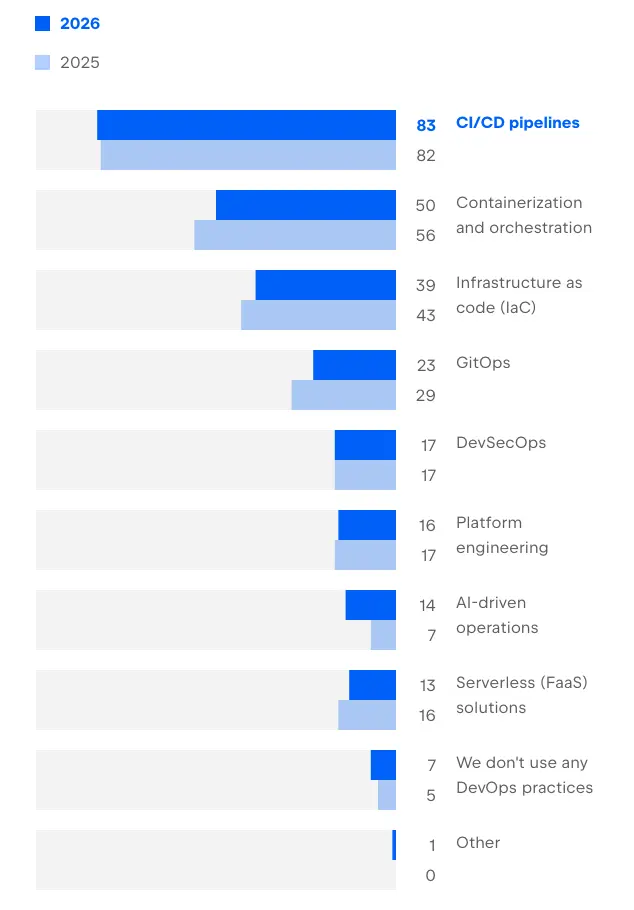
CI/CD is still at the center of software delivery (Source: JetBrains)
Client demands and legacy systems drive tool choices
GitHub Actions leads organizational adoption, followed by GitLab CI and Jenkins. Azure DevOps Server ranks next, ahead of TeamCity. Other tools include AWS CodePipeline and CodeBuild, Bitbucket Pipelines and custom systems.
Organizations using several CI/CD tools cite different client requirements, technology stacks and inherited systems. Departments working with different customers may need to use tools specified by those customers.
Most developers have no plans to switch CI/CD tools. Those considering a change cite scaling costs, maintenance effort, tool consolidation and configuration complexity.
Self-hosting remains widespread
72.8% of respondents run their primary CI/CD system on their own premises or on self-managed cloud infrastructure. On-premises installations reached their highest share in the five years covered by the hosting question.
Hosting choices show teams’ needs for control over hardware, networks, data, build environments, security and costs, supporting a mix of deployment models.
“Most AI use currently happens around the pipeline. Teams use it to review code, write or fix tests, and diagnose build failures. At the same time, self-hosting remains an important part of the CI/CD landscape, especially for organizations that need more control over their infrastructure, data, security, or costs,” said Olga Bedrina, Product Marketing Manager for TeamCity.
AI supports testing and troubleshooting
48.8% of surveyed organizations use AI for at least one CI/CD-related task. Only 8% report running AI-powered steps directly within a build or test.
Other applications include maintaining pipeline configurations, quality or security checks that can block a build, assistance with deployments and releases, and incident response following deployment.
Developers access CI/CD tools through MCP servers and agent skills, connecting assistants they already use to their development workflows. Web interfaces remain the most common way respondents interact with these systems.
Organizations reporting no AI use in CI/CD cite its low priority, data privacy and intellectual property concerns, satisfaction with their existing setup and cost. Smaller companies are more likely to say their current approach works well enough without AI.
Teams using AI report that the volume of generated changes slows reviews and makes reliability difficult to assess. Other concerns include unpredictable AI costs, tracking which changes were made by AI and debugging issues it introduces.