
MOS: Open-source modular OS for servers and homelabs
A growing number of homelab builders and small server operators are testing an open source operating system that combines basic server management, storage control, and container services under a web interface. MOS is a free modular OS built on a Devuan base that provides a web UI and API for system monitoring, storage pooling, container orchestration, and virtualization.
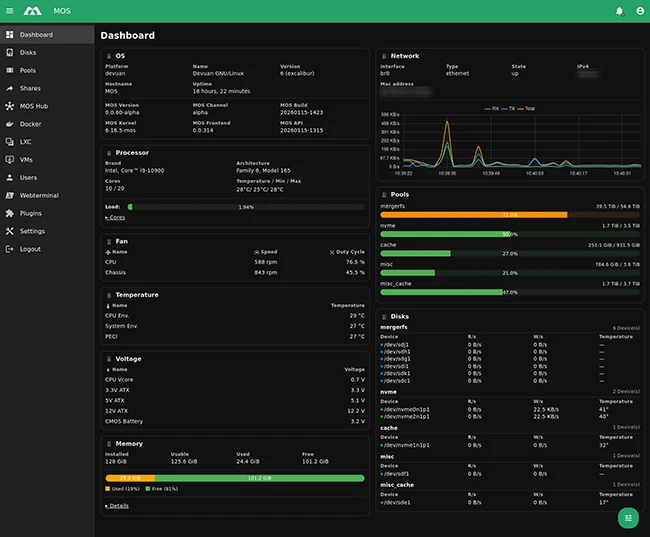
Web UI and API for server and homelab management
MOS presents a browser-accessible dashboard that gives status information about CPU, RAM, storage devices, network interfaces, and system notifications. The interface includes modules for managing storage pools, file shares, users, and service settings. Docker containers, LXC containers, and virtual machines appear in the interface when their corresponding services are active. A real-time WebSocket connection augments the REST API, providing live notifications and events to the interface. 
User accounts and roles can be configured within the interface, with access tokens used for authentication. The system is designed so that external automation tools and custom integrations can work with the API directly. System logs, cron jobs, and service configuration settings are exposed in the UI alongside core system details.
Storage and plugin approach
MOS supports flexible storage arrangements. It includes built-in support for combining disks into a single logical pool using mergerfs and for snapshot-based parity protection using SnapRAID. Additional storage drivers are available through a central repository of plugins. These plugins extend the storage capabilities beyond the default set.
Hardware drivers, such as those for GPU or digital video broadcasting hardware, can also be provided as plugins. MOS Hub is a component that provides a catalog of plugins and templates that operators can deploy to extend the base system capabilities.
System services and notifications
Within MOS, system services such as Docker and LXC are enabled or disabled through service configuration settings. Operators can control the Docker daemon, configure networking for containers, and set storage locations. Logs and system events feed into a notification service implemented in Go that delivers alerts within the web interface.
Network settings, service tokens, and general system options are bundled in the settings module. The goal of unifying these elements in a single interface is to reduce the need for frequent context switching between command-line tools and external dashboards.
MOS is available for free on GitHub.

Must read:
- 40 open-source tools redefining how security teams secure the stack
- Firmware scanning time, cost, and where teams run EMBA

Subscribe to the Help Net Security ad-free monthly newsletter to stay informed on the essential open-source cybersecurity tools. Subscribe here!
