
9 out of 10 people can no longer distinguish real from AI-generated content
Online fraud is becoming harder to distinguish from legitimate activity as AI-generated messages, voices, photos, reviews, and identities become more convincing.
Nearly nine in ten adults say they can no longer tell what is real from AI-generated content, according to the latest Malwarebytes survey. The share increased from 66% in 2025 to 85% in 2026.
The survey covered 1,500 adults aged 18 and older in the United States, the UK, Austria, Germany, and Switzerland.
Trust becomes harder to maintain online
Half of respondents said they had encountered an AI-driven scam during the past year. Personalized scam messages, manipulated product reviews, AI-generated images, and voice impersonation were among the experiences reported.
Identity abuse was another recurring theme in the survey. Some people reported having their identities manipulated by AI, while others described receiving voice-cloned calls that appeared to come from someone they knew. Younger adults reported higher levels of exposure than older age groups.
One respondent described receiving an AI-generated call that mimicked the voice of someone familiar. “It was very frightening. Since then, I am much more cautious with unknown numbers and no longer immediately trust voice messages.”
Technology companies are introducing new safeguards to address the problem. Google recently expanded Android’s scam detection capabilities to help identify suspicious calls and protect users from impersonation scams.
Consumers are sharing less online
Many people said they are changing how they use the internet and social media. Some reported posting less personal content, removing older posts, or limiting information shared about themselves and their families.
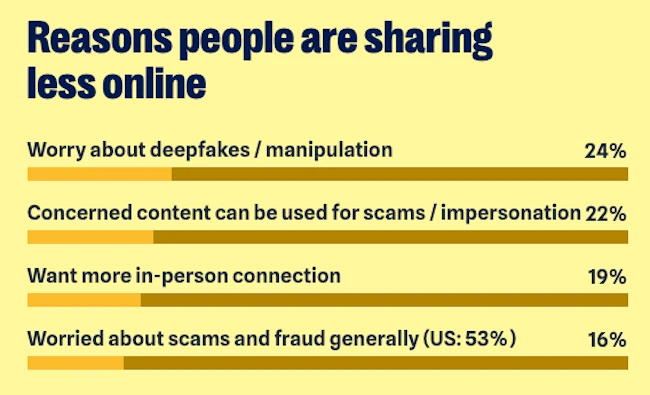
Reasons people are sharing less online (Source: Malwarebytes)
Deepfakes, impersonation, and online fraud were among the reasons given for reducing online activity. Others said they wanted more in-person interaction or were worried about scams more generally.
Despite widespread concern about AI-enabled fraud, relatively few respondents reported taking specific protective measures such as creating family code words, requesting data removal, or watermarking photos.
People still see benefits in AI
Views on AI were not entirely negative. Some people said they use the technology to edit photos, write messages, and help with personal projects.
Others said AI should not be judged solely by scams and misinformation. They believe the technology can be useful in everyday life if stronger rules are introduced to curb abuse.
Misinformation enters a new phase
AI is also having a growing impact on geopolitics, polluting the media landscape, amplifying misinformation, and sowing distrust.
“Seeing more and more sophisticated fake posts on social media makes me think we’re quickly approaching a post-truth reality,” said one respondent.
OpenAI is preparing for the 2026 election cycle with measures designed to improve transparency around AI-generated content, provide reliable voting information, support cybersecurity defenders, and restrict deceptive political uses of its tools.
Researchers at the Vector Institute argue that deepfake detection, as a standalone technical capability, is losing ground and is likely to continue losing ground as generative models improve.
