
What motivates hackers and what makes them walk away
Most hackers spend more time learning, testing, and comparing notes than breaking into systems. The work often happens alone or in small groups, shaped by curiosity, persistence, and a habit of examining how systems behave.
Bugcrowd examined who these security researchers are, how they build skills, and what their work looks like behind the scenes as they look for flaws and decide what to report.
Who makes up the hacker community
The hacker community includes people from varied backgrounds, which influences how vulnerability research is approached and shared. Some work in security or IT roles, while others come from unrelated fields and pursue security research alongside other work.
Education paths vary, with some having formal training and others being self-taught, but most spend significant time learning new systems and refining skills. The study also notes a strong presence of neurodivergent individuals, reflecting how this work rewards focus, pattern recognition, and systems thinking.
What drives hackers
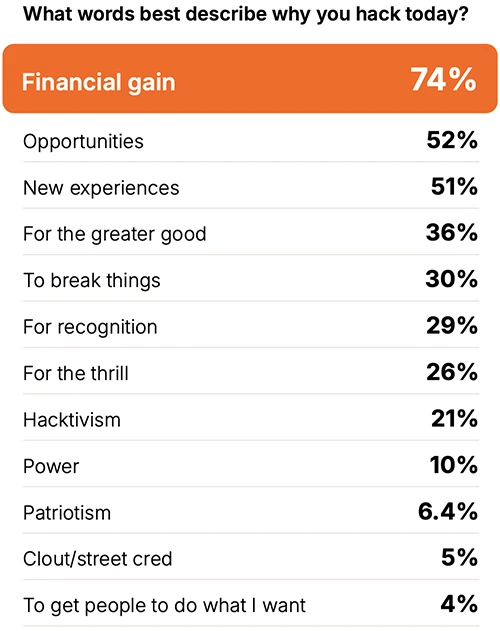
Hackers describe a mix of financial reward, learning, and professional growth as reasons they stay involved. Many view hacking as skilled labor that requires patience and judgment, and they take pride in the quality of their findings.
Economic pressure and geopolitical tension influence how this work is perceived and where effort is directed. Some researchers say security testing feels more connected to global events and state interests than in the past, which affects how risk and responsibility are weighed.
Disclosure decisions ultimately come down to trust. People want to report serious issues, but when it’s not clear how or where to report them, that good intent can stall or disappear altogether. Legal gray areas, silence from the organization, and uncertainty over who actually owns the issue all play a role in whether findings ever get shared.
Why teams matter
Many practitioners already work in teams, and many others want to. Collaboration allows people to combine skills and spend more time on complex problems that are difficult to pursue alone.
Work is often divided by strength. One person may focus on reconnaissance, another on application logic, and another on exploitation. This structure reflects how attacks are organized and supports deeper testing across systems with many dependencies.
Researchers say teams help them move faster and maintain focus. Shared context reduces duplicated effort, and ongoing collaboration builds trust. Smaller teams tend to work best, supporting communication while covering a range of skills.
How AI fits into work
Hackers use AI to handle time-consuming tasks such as sorting scan results, reviewing code, and summarizing large data sets. This shifts effort toward hands-on testing and analysis.
When security researchers encounter unfamiliar frameworks or errors, they use AI to understand behavior and explore options without losing momentum. It serves as a reference and troubleshooting aid rather than a decision-maker.
Hackers continue to rely on experience and intuition to decide what matters, where to dig deeper, and how to explain impact. AI helps manage scale and repetition, while people remain responsible for direction and conclusions.
“While the industry often frames the AI conversation as a choice between humans and machines, we have reached a point where those forces are converging,” said Dave Gerry, CEO, Bugcrowd.