40% of organizations struggle to retrace AI agents’ actions
99% of organizations use AI agents to perform autonomous or semiautonomous actions in development pipelines, according to Palo Alto Networks’ State of Cloud Security Report 2026. Meanwhile, 82% say AI-driven development has increased the volume of updates to cloud infrastructure.
Release pressure leaves security issues unresolved
AI’s role in cloud development now extends to designing architectures and automatically deploying applications to production. Nearly three-quarters of organizations grant agents permission to modify code, CI/CD configuration or production environments.
An agent’s actions can receive approval before their security risks are understood. Reviewers may approve changes before the associated dependencies, secrets, images or infrastructure have been inspected. Only 37% of organizations enforce manual security reviews, while 33% can trace code from commit to cloud runtime across most production workloads.
Infrastructure as code enables faster provisioning but also increases the risk that misconfigurations will reach cloud environments before security teams can detect and address them, particularly when predeployment controls cannot keep up.
Organizations enforce fewer than three of the eight predeployment security checks measured on average and use a similarly limited set of CI/CD safeguards.
On average, 19% of high- and critical-severity application security issues reached production during the preceding 90 days. Organizations take an average of 18.4 days to deploy a fix to production after identifying a security issue in code.
Business pressure to release software quickly hinders predeployment remediation for 39% of organizations, while 35% cite concerns about slowing development. Revenue targets, customer commitments and tight deadlines can leave little room for security fixes.
Undefined risk acceptance is a major barrier for 30% of organizations. Without explicit criteria, known vulnerabilities can reach production without agreement on who owns the exposure or when fixes are due. This barrier ranks second in Germany and India, where it is cited by 37% and 36% of organizations, respectively.
Release pressure is the leading barrier in North America, Europe, the Middle East and Africa, and Japan and Asia-Pacific. Limited developer ownership tops the list in Latin America. Other leading challenges include difficulty identifying the most critical security findings and gaps in integrating security into development workflows.
Shared identities complicate oversight of AI agents
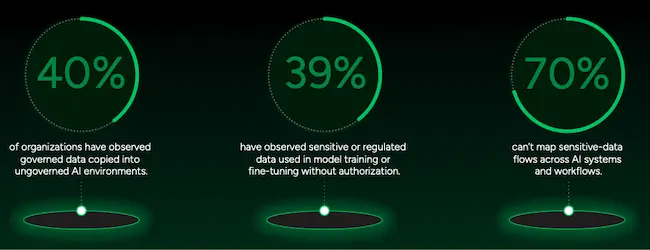
Forty percent of organizations have been unable to reconstruct an AI agent’s actions. That rises to 46% in the financial sector, the highest of any industry surveyed.
Recording agent activity under developers’ identities can leave investigators struggling to distinguish human actions from those performed by agents. 53% of engineers log agent actions under their own identities or personal access tokens. Revoking a credential can disrupt services that depend on it, requiring security and engineering teams to coordinate replacement access. Undocumented ownership and dependencies further complicate responses to incidents involving unmanaged agent credentials.
Data moves beyond governed boundaries (Source: Palo Alto Networks)
Forty-three percent of organizations found AI agents or automated workflows operating without security approval or oversight in the past 12 months. Organizations take an average of 2.5 days to revoke or rotate compromised developer credentials, API keys or pipeline secrets.
Only 9% can automatically discover and classify ungoverned AI activity across cloud environments, while 70% cannot map sensitive-data flows across AI systems and workflows.
Even though 97% of organizations are at least somewhat confident in their ability to execute a security strategy for protecting their AI supply chain and applications, only 36% can monitor AI behavior in production and 30% can detect prompt injection.
With AI agents gaining control over cloud resources, security teams need to detect manipulation, check that agents use access as intended and stop them when problems occur.
Security teams lack the context to prioritize fixes
Frontier models can discover zero-day vulnerabilities, chain logic flaws and generate working exploits across complex systems in minutes, putting internal remediation targets under pressure.
Sixty-five percent of organizations consider frontier AI-powered capabilities a significant or severe threat to global critical infrastructure and financial systems over the next 12 to 18 months.
Regional priorities combine AI-specific controls with improvements to established security operations. Ownership and coordination across identity, data, application and security operations center teams will form how these capabilities work together.
Nearly half of organizations manually correlate application vulnerabilities with runtime environments and active threats. A lack of runtime context can lead these organizations to spend engineering time fixing nonexploitable flaws because they cannot determine which vulnerabilities are exposed to active threats.
Only 19% of organizations operate with unified telemetry and workflows across code, cloud, identity and runtime environments.