
What consumers expect from data security
Security teams spend years building controls around data protection, then a survey asks consumers a simple question about responsibility and the answer lands close to home. Most people believe they are in charge of their own data privacy, and they want systems that support that belief, according to the 2025 Data Privacy Research from the Software & Information Industry Association. The study examines how people view responsibility, cost, and acceptable data use.
Personal agency shapes privacy expectations
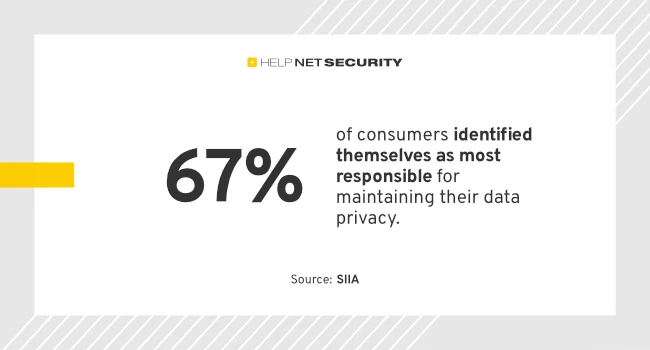
When respondents were asked who is most responsible for maintaining data privacy, 67% selected themselves. Federal consumer regulatory agencies and technology companies each received 36%, while state and local agencies registered at 10%.
This view reflects an expectation that personal choices matter. People see their own actions, settings, and decisions as a primary layer of defense. Government and companies still play a role, though consumers do not view those actors as the starting point.
Security controls that rely on transparency, informed consent, and understandable choices align with how users already think about privacy. The survey suggests that trust grows when systems support decision making instead of obscuring it.
Price matters when privacy becomes practical
The study tested privacy preferences using a practical scenario. Participants chose between two email services. One option offered a free, ad supported service that scans email content for features and advertising. The other offered a paid service at five dollars per month with no scanning.
More respondents chose the free option than the paid one. A sizable group declined both choices.
This result shows how privacy concerns interact with everyday decisions. People value privacy, though many still choose services that rely on data use when cost enters the equation. Security leaders working on consumer products often see this behavior firsthand. The findings show that price sensitivity remains part of privacy decision making.
“Overbroad restrictions on data use will not only restrict the availability of the free services that consumers prefer, but also interfere with societally valuable activities like law enforcement investigation and fraud prevention. Consumers expect that companies will use their data as the consumer directs, and do not object to the use of that data to invisibly prevent fraud on their Amazon account. What that means for policymakers is that there is a constructive path forward that balances these interests,” said Chris Mohr, President, SIIA.
Security driven data use earns trust
The research also measured comfort with specific uses of personal data. Respondents expressed high comfort with data used to prevent fraud, detect identity theft, and secure online transactions.
These uses ranked higher than those connected to personalization or advertising. Consumers appear to evaluate data use based on visible benefit.
When data collection and analysis support safety outcomes, acceptance increases. Communicating that connection strengthens trust in security programs and monitoring practices.
Guardrails change attitudes
The study examined what happens when consumers feel uneasy about a particular data use. Two safeguards consistently improved comfort levels. One involved frameworks governing government access to data. The other involved privacy enhancing technologies such as encryption and anonymization.
Across multiple scenarios, respondents who initially expressed discomfort said these guardrails would shift their view. In each category, a majority reached a level of comfort once these protections were introduced.
This finding matters for security architects. Technical protections and policy clarity work together. Encryption, anonymization, and access controls reduce risk. Governance and oversight address concerns around misuse. The combination aligns with consumer expectations across many use cases.
Third party access remains context driven
Comfort with third party access varies by purpose. Uses connected to security and fraud detection receive higher acceptance than those tied to advertising or behavioral analysis.
Across categories, only a small portion of respondents said no safeguards would ever make them comfortable. Most showed willingness to accept data sharing under defined conditions.
This suggests that context and controls shape acceptance. For cybersecurity professionals managing vendor access, data sharing agreements, and service integrations, the results point toward targeted controls and defined purposes.