
Public mobile networks are being weaponized for combat drone operations
On June 1, 2025, Ukraine launched a coordinated drone strike on five airfields inside Russia, disabling or destroying aircrafts. The attack involved more than 100 drones carrying explosive payloads and targeting aircraft on the ground.
The drones used mobile networks to transmit telemetry, receive instructions, and send back images during the operation, highlighting the integration of civilian mobile networks into combat drone operations.
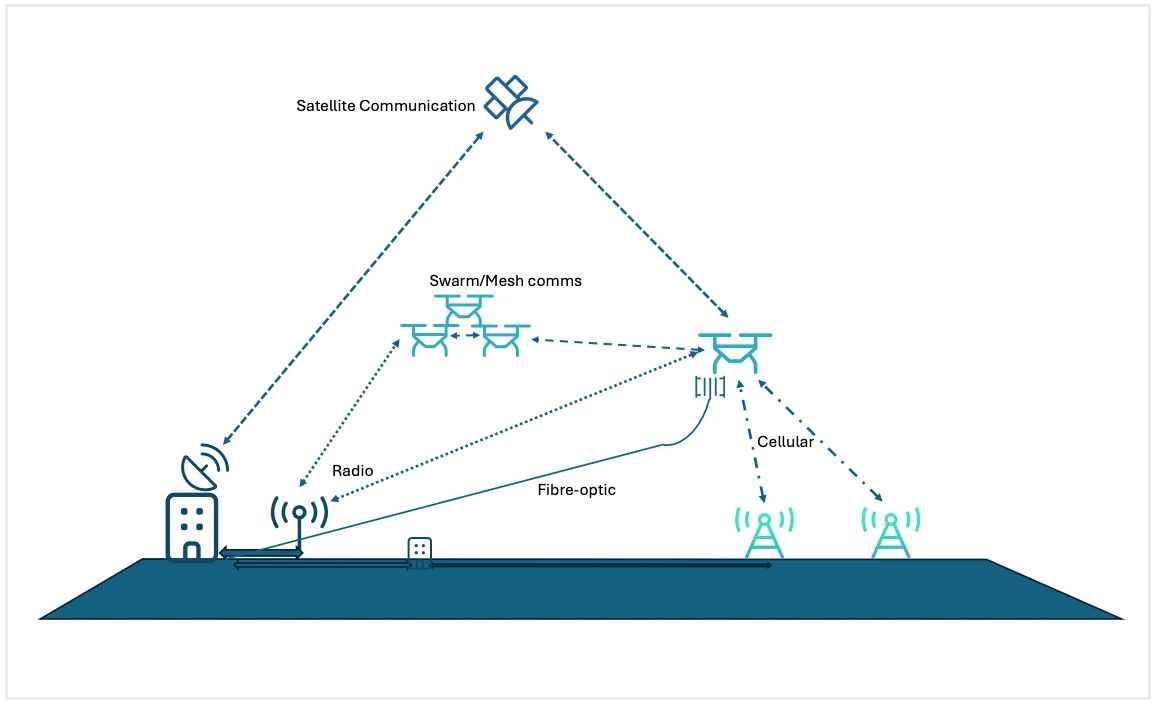
Types of UAV Communication Systems (Source: Enea)
Enea researchers examined the progression of that integration, how mobile-connected drones have been used in conflict, and what the trend signals for national infrastructure.
From experiments to battlefield deployment
Over the past two decades, drones have become embedded in military operations. They conduct reconnaissance, support strike missions, relay communications, assist with resupply, and contribute to electronic warfare. Advances in airframes and onboard computing have expanded their capabilities. The spread of commercially available components has increased availability and accelerated deployment from development to battlefield use.
Mobile operators began testing drone connectivity in the mid-2010s, following the rollout of 4G networks. Early trials examined signal strength, mobility between cells, and interference patterns at altitude.
By 2017, the 3rd Generation Partnership Project, or 3GPP, the global body that sets technical standards for 3G, 4G, and 5G networks, had begun formal work on enhanced LTE support for aerial vehicles. That effort led to updates incorporated into Releases 15 through 18, adding technical provisions to better support drones operating on cellular networks.
While civilian telecom research moved steadily toward drone support, military institutions showed limited public focus on cellular-connected drones prior to 2022. That gap narrowed once the war in Ukraine intensified technological experimentation on both sides.
The first Russian experimentation in the use of mobile networks for drone communications was reported in late 2023. Recovered long-range drones contained 4G modems paired with local SIM cards. These systems transmitted position data, allowing operators to determine where drones were intercepted. This initial phase focused on telemetry.
The shift from telemetry to video
By early 2024, recovered drones included onboard cameras linked to 4G modems. Video feeds were transmitted through the mobile internet, sometimes routed via messaging platforms. This allowed operators to observe air defense responses and assess strike outcomes in near real time.
At this stage, 4G connectivity was required to transmit usable video, which meant operations were limited to areas with sufficient network coverage.
Later in 2024, some Russian FPV-type drones were reported to use LTE for telemetry, video, and command functions. In one case, a drone carried multiple modems, including two 4G units and a 2G modem, indicating layered connectivity and redundancy.
Use across drone categories
Communication choices are driven by mission objectives, distance, bandwidth requirements, and the level of electronic warfare in the area.
The research reviews roughly 30 drones used in the conflict and finds mobile connectivity across a wide range of payloads and flight times. Cellular technology supports diverse drone classes when operational conditions align.
Mobile networks are selected for medium- to long-range missions, especially those conducted behind enemy lines with moderate to high data needs. They are also chosen when weight, power consumption, and cost must be kept low. In some cases, mobile networks are used because satellite access is unavailable, restricted, or impractical.
“The fact that the functionality of mobile connected drones has increased during the war, not decreased, leads us to believe that it is highly likely mobile-connected drones in conflict will continue. This remains the case even if there is experimentation with other communications systems, or indeed no communication system at all,” said Cathal McDaid, VP of Technology at Enea.
“Mobile networks will never become the only way that drones in war could be communicated with, in fact it will probably only be used by a minority of devices. However, experience shows us that it has been widely used for specific types of missions, due to its cost, weight and sheer usefulness. One area of particular use is for control of offensive drones behind enemy lines; this is liable to be an area of particular interest for both state and non-state actors,” McDaid continued.
Russian and Ukrainian forces have used mobile links for strikes launched far from the front line, often with lightweight drones. Cellular networks provided reach and data capacity suited to these missions.
Drone communications in Ukraine follow a modular approach. Operators combine radio, satellite, fiber, mesh, and mobile links based on mission design.
Ukrainian deployment and remote strikes
Public reporting on Ukrainian cellular-connected drones is more limited, though the report cites several incidents beginning in mid-2023. Some systems appear to have used SIM cards to transmit position data or enable remote activation once placed in border regions.
A long-range strike in 2025 demonstrated the use of mobile networks inside Russian territory. Open-source radio measurements cited in the study indicate 4G coverage near targeted airbases. Video footage suggests telemetry, video, and control were transmitted via LTE.
Following the attack, Russian authorities increased temporary shutdowns of mobile service in affected regions. The report links these actions to recognition of cellular networks as a channel for drone control.
What else could drones use to communicate
Mobile networks are used to transmit information to and from drones. Drones also rely on other communication technologies, including line-of-sight radio systems, satellite links, and direct fiber-optic connections.
Line-of-sight radio supports short- to medium-range missions and low-latency control. Satellite links extend reach beyond the front line but add weight and depend on satellite access. Fiber-optic control avoids jamming and supports high data rates, though range is limited by cable length. Mesh systems relay signals between drones and extend coverage when enough nodes remain active.
Mobile networks are selected for medium- to long-range missions in areas with civilian coverage. They require limited onboard power and support telemetry, video, and, in some cases, control.
Future developments
The researchers assessed the impact of future innovations on mobile-connected drones and identified two areas.
One is satellite-to-mobile integration, where cellular modems connect directly to low-earth orbit satellites. Early deployments have begun in some regions, with data services expanding over time. This approach extends cellular-style connectivity beyond terrestrial coverage.
The second is increased autonomy. Reports from late 2025 describe drones without LTE modems, indicating onboard AI guidance without live communication. Autonomous systems support navigation and targeting while reducing reliance on external networks.