
Cloud operations become the next big role for agentic AI
Companies are using agentic AI to manage growing application environments, automate routine tasks, and support decisions. Business and IT leaders increasingly see the technology as part of cloud application management, according to Unisys’ AI & Cloud Insights Report.
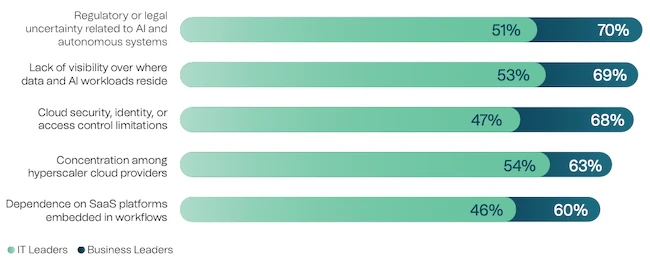
To what extent do the following factors limit your organization’s ability to scale agentic AI safely? (Chart shows those answering “moderate/major limitation.”) (Source: Unisys)
Most organizations remain in testing or early deployment. Nearly one quarter have started scaling agentic AI across business functions. Early uses center on employee productivity and cloud management. Spending plans show continued interest, with half of respondents planning higher investment during the next year.
Successful deployment depends on preparation. Companies reported progress in identifying priority use cases, securing executive support, training employees, working with technology vendors, and setting governance rules. These efforts support broader agentic AI deployment across departments and workflows.
“The organizations winning right now have figured out how to turn what they already have into outcomes their boards can see and measure. The technology itself matters less than the discipline to act on it,” said Mike Thomson, CEO and President at Unisys.
The main concerns involve day-to-day control. Organizations cited limited visibility into the location of data and AI workloads, cloud security, provider concentration, and regulatory uncertainty. Business leaders reported higher concern across the measured risk categories.
Concerns about trust and employment have declined. Fewer respondents linked agentic AI to job displacement, bias, hallucinations, or limited human empathy. Experience with the technology has moved attention toward deployment rules, workload oversight, and access controls.
Infrastructure supports wider AI use
Confidence in data architecture and automation has increased. Most business and IT leaders said they have the architecture and tools needed to support data-driven decisions. Nine in 10 organizations said they are using automation to streamline and optimize IT environments.
Operational performance exceeded expectations at a smaller share of organizations than in the previous survey. A shortage of skilled workers and data management and integration remain the leading IT issues.
Investment plans remain active across cloud infrastructure, cloud applications, automation, generative AI, and zero trust. Organizations are using more public and private cloud services. Edge, sovereign, and industry cloud environments have gained use in sectors with specific data, location, and compliance requirements.
Expanding cloud environments add management demands. Each platform can introduce separate controls, data locations, service dependencies, and access rules. Companies need consistent oversight across these environments to support cloud operations and AI workloads.
Application work stays focused on technology
Application modernization efforts focus on technical upgrades and AI support. Enabling AI and automation ranks near the top of the stated objectives, followed by resilience, cost reduction, customer experience, and speed to market.
Integration with existing systems remains the leading application strategy challenge. Legacy systems, technical debt, and ongoing optimization work also slow projects. Many companies are moving older applications to cloud environments and adapting them for cloud-native use.
Keeping older systems in operation leaves services spread across legacy, cloud, and hybrid environments. This adds dependencies and makes application management harder. Retiring more legacy applications could help reduce that complexity.
Security controls guide AI deployment
Agentic AI gives software systems access to enterprise data, applications, and business processes, increasing the need for identity controls, access management, workload visibility, and defined limits on system authority.
Nearly half of surveyed organizations experienced a cybersecurity breach during the prior year. They are using managed detection and response, identity governance, privileged access management, and continuous threat exposure management to support security operations.
Cloud security capabilities influence the amount of autonomy organizations assign to AI systems. Data sovereignty requirements affect workload locations, with regional deployment serving as a common response.
Security and governance controls are becoming part of AI planning from the start. These controls set rules for data access, system authority, workload placement, and accountability. Respondents expect these controls to limit agentic AI deployment in the near term. The same controls provide the operating boundaries needed for wider use across business functions.
