
Most consumers aren’t ready to let AI agents shop unsupervised
Customer control, account security and ease of use are influencing the adoption of AI agents that make purchases, book services and access personal information, according to Okta’s 2026 Customer Identity Trends Report.
Consumers’ willingness to delegate depends on what an agent can do, the consequences of a mistake and their ability to approve or reverse its actions. Businesses introducing these services must meet new requirements for verifying agents and managing their permissions.
Only 37% of North American consumers are ready to let AI make final decisions and act on their behalf or handle routine tasks and less important decisions. Willingness exceeds 50% for most use cases when people can approve or undo an action.
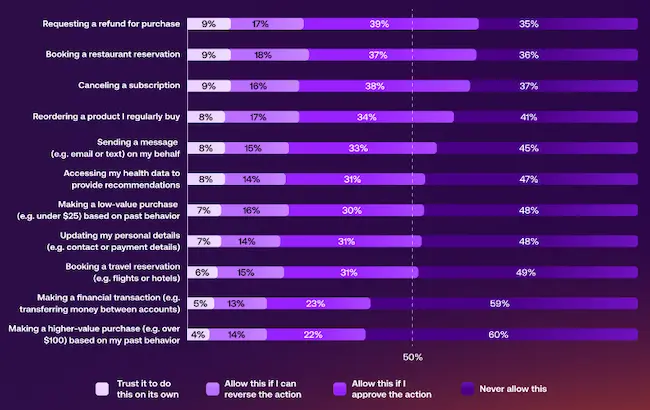
How willing would you be to allow an AI tool to take the following actions on your behalf? (Source: Okta)
Consumers set limits on delegation
The speed of development is contributing to consumer unease. Globally, 52% of consumers say AI capabilities in apps and websites are advancing too fast.
Comfort with delegation varies by age and familiarity with technology. Younger consumers and early adopters are more receptive to handing over decisions. Older consumers and people who adopt technology later are more hesitant.
Businesses need to accommodate these preferences. Someone asking an assistant to find a flight may want to approve the ticket, decide whether it can use saved payment details and review changes to the booking.
Explaining those permissions and providing ways to withdraw access can help customers decide how much responsibility to hand over.
Identity requirements slow delivery
More than three-quarters of North American developers and senior leaders said their companies have AI agents or autonomous systems in production or are building them. Only 22.1% of organizations pursuing these capabilities are progressing at their intended speed.
Respondents cited shortages of engineering capacity and identity infrastructure that cannot support agent access as reasons for delays.
Customer identity and access management handles sign-ins, account access and permissions. Engineering teams in the region spend roughly 14% of their time building, maintaining or operating these systems. Many respondents describe this work as a recurring cost and time drain.
“When identity infrastructure falls short, teams are more likely to build makeshift workarounds that can put sensitive customer data at risk,” Gareth Davies, CPO at Auth0.
Access needs to match the task
An agent checking an order’s delivery status needs shipping information. Changing an address or authorizing another purchase requires additional permission.
Giving agents their own identities helps companies enforce those boundaries. Credentials can expire after a task or a set period, with access restricted to the information and actions required.
Records of agent activity help teams investigate errors and unauthorized access. If a transaction goes wrong, the company needs to establish which agent acted, what permission it had and what happened.
Shared accounts and credentials embedded in software can complicate that process. They can expose connected services if an agent is compromised.
Platforms can reduce maintenance
Across the global findings, organizations relying solely on an external customer identity platform were more likely to have AI features in production and keep deployments on schedule. They reported greater use of authentication that simplifies account access while protecting customer interactions and revenue.
These outcomes show an association between platform choice and deployment progress. They do not establish that the platform caused the difference.
Centralizing identity checks and permissions can reduce work developers would otherwise repeat across applications, giving them more time to build customer features. Those features need to make approval requests understandable, explain additional verification and let customers regain control when something goes wrong.
