Fraudsters feed the right face into identity checks through virtual cameras
Document fraud remains the largest attack category in Entrust’s The Professionalization of Fraud: 2027 Identity Fraud Report, with criminals combining physical counterfeits, digital manipulation and impersonation to target online services.
The document fraud rate fell 19% year over year. Attacks classified as medium sophistication accounted for nearly 39% of document fraud, involving alterations and counterfeits that require closer inspection to detect. Physical counterfeits made up 61.1% of fraudulent document submissions.
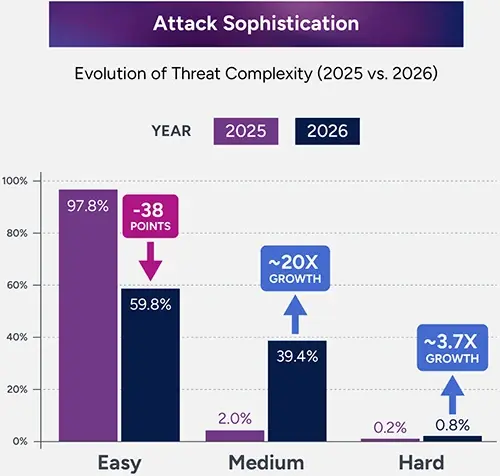
Attack sophistication (Source: Entrust)
“Fraudsters are investing in better templates, stolen credentials, and specialized skills to make attacks more convincing. AI is accelerating this shift, helping fraudsters scale operations and target multiple points across the identity lifecycle,” said Simon Horswell, Senior Fraud Specialist Manager at Entrust.
Deepfakes target identity checks
Deepfake detections rose 165% year over year. Criminals use AI-generated IDs, photos and videos to impersonate customers during verification. These attacks can be personalized, automated and repeated across services, increasing the reach of an operation.
Creating the image or video is a stage in the attack. The content must enter the verification process and pass security checks before criminals can use the resulting access to commit fraud.
Financial services attract these attempts because verified accounts provide access to funds and can support money laundering, money mule activity and subsequent fraud. An account opened using a fraudulent identity can become a resource criminals reuse.
Injection attacks deliver the impersonation
Injection attacks feed images or video into verification software, bypassing the device’s camera. A virtual camera can present fabricated footage as a live recording, while device emulation software imitates the phone or computer submitting it.
Stolen photographs and videos can enter the same process. Genuine media gives criminals material they can replay without creating a synthetic identity. A photograph may be authentic even when the person submitting it has no right to use it.
Device intelligence examines the camera, device and session involved in a submission. The fraud rate measured through device intelligence rose 42% year over year.
Social engineering turns victims into participants
Social engineering exploits trust. Attackers manipulate customers or employees into approving transactions, disclosing information or completing identity checks.
A customer following a scammer’s instructions can complete verification with genuine documents and biometric information. An employee can authorize actions that expose an organization to fraud.
Criminal groups specialize in different stages of an operation, coordinating the people, tools and information needed to carry it out. This division of labor helps them repeat attacks and target several points in a customer relationship.
Regional differences
Europe recorded the largest regional share of deepfake attacks in the company’s dataset, with detections growing 462% year over year. Physical counterfeits accounted for 64.2% of document fraud, and digital forgeries represented 26.4%. Digital forgeries led in Italy, physical counterfeits dominated in Spain, and medium-sophistication attacks outnumbered easy attempts in the UK.
The Americas recorded the highest document fraud rate and the fastest growth in deepfake attacks. Driver’s licenses were the most targeted credentials across the region, including licenses from Texas, California and Florida. National identity cards dominated fraudulent submissions in Latin America, where Chile’s national ID was the most frequently targeted individual credential.
Asia-Pacific had the highest proportion of digital forgeries and the second-largest share of deepfake activity. Criminals often altered document images submitted through online and mobile registration processes. Most document fraud attempts were classified as easy, with medium-sophistication attacks increasing. Social engineering had the lowest recorded rate of the regions studied.